

/
Making skin health accessible for all: unveiling the challenges in diagnosing skin conditions on darker skin
Increase in men accessing healthcare during pandemic
February 15, 2021
The skin is the largest organ of the human body and acts as a protective barrier between the external environment and the inside of the body, shielding the internal organs against heat, light, injury and infection. Yet, the journey to diagnose skin conditions, especially on darker skin tones, can be challenging and not well mapped. In a recent study, physicians were presented with 364 images spanning 46 skin diseases and asked to submit up to four differential diagnoses. The physicians were four percentage points less accurate for the diagnosis of images of dark skin as compared to light skin.
Inherent biases deeply rooted in medical research, literature, and education have led to a healthcare landscape skewed towards lighter skin, often leaving behind those with darker complexions. Doctors diagnose around one-quarter of melanoma cases in Black people when cancer has already spread to nearby lymph nodes. However, amidst these challenges, there are technological advancements, such as AI, that are helping to rectify this imbalance. In May 2024, Autoderm conducted a total of 18,359 analyses through the myGP app and identified 79 cases of melanoma. This equates to about 2-3 melanoma diagnoses per day. Given that approximately 46 melanomas are diagnosed daily across the UK, the cases detected via the myGP app represent about 5% of the total daily melanoma diagnoses in the UK population.
We recognise the need for equitable healthcare solutions for all. Through our partnership with Autoderm, launched in 2023 after years of clinical and AI research, are proud to offer their next generation skin scanner to our community of 3 million users via the myGP app.
The bias in dermatology towards lighter skin tones is a well-documented issue. From medical textbooks to research studies, most visual references and diagnostic criteria are based on observations of mainly fair-skinned individuals.This bias perpetuates a cycle of misdiagnosis and inadequate treatment for patients with darker skin, which can lead to unnecessary distress and prolonged health issues such as increased itching, dryness, skin thickening and hyperpigmentation.
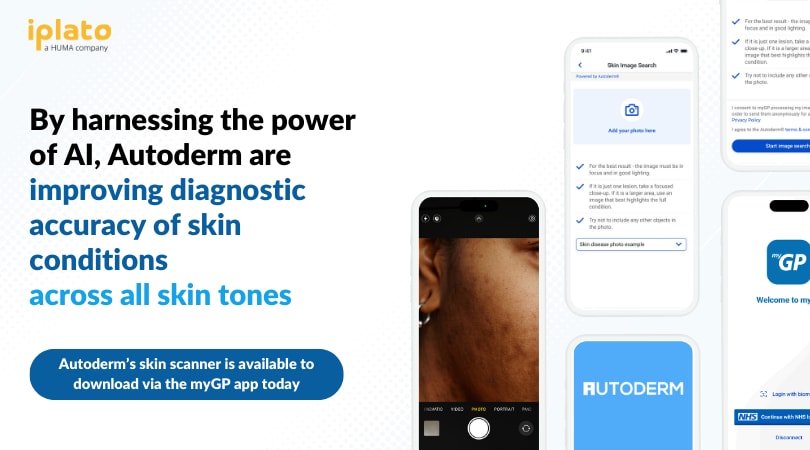
Autoderm and the myGP app, however, are changing the game! By harnessing the power of AI, Autoderm helps improve diagnostic accuracy of skin conditions across all skin tones. Their approach analyses a diverse search engine of skin images (2 million+), encompassing various ethnicities and skin tones. Their algorithm is constantly evolving and learning along with their growing bank of images. Irrespective of skin tone, myGP users can use the tech to get likely answers quickly, easily and choose how to act on the insight.


© 2026 iPLATO. All rights reserved
Practice Area
/
Making skin health accessible for all: unveiling the challenges in diagnosing skin conditions on darker skin
Increase in men accessing healthcare during pandemic
February 15, 2021
The skin is the largest organ of the human body and acts as a protective barrier between the external environment and the inside of the body, shielding the internal organs against heat, light, injury and infection. Yet, the journey to diagnose skin conditions, especially on darker skin tones, can be challenging and not well mapped. In a recent study, physicians were presented with 364 images spanning 46 skin diseases and asked to submit up to four differential diagnoses. The physicians were four percentage points less accurate for the diagnosis of images of dark skin as compared to light skin.
Inherent biases deeply rooted in medical research, literature, and education have led to a healthcare landscape skewed towards lighter skin, often leaving behind those with darker complexions. Doctors diagnose around one-quarter of melanoma cases in Black people when cancer has already spread to nearby lymph nodes. However, amidst these challenges, there are technological advancements, such as AI, that are helping to rectify this imbalance. In May 2024, Autoderm conducted a total of 18,359 analyses through the myGP app and identified 79 cases of melanoma. This equates to about 2-3 melanoma diagnoses per day. Given that approximately 46 melanomas are diagnosed daily across the UK, the cases detected via the myGP app represent about 5% of the total daily melanoma diagnoses in the UK population.
We recognise the need for equitable healthcare solutions for all. Through our partnership with Autoderm, launched in 2023 after years of clinical and AI research, are proud to offer their next generation skin scanner to our community of 3 million users via the myGP app.
The bias in dermatology towards lighter skin tones is a well-documented issue. From medical textbooks to research studies, most visual references and diagnostic criteria are based on observations of mainly fair-skinned individuals.This bias perpetuates a cycle of misdiagnosis and inadequate treatment for patients with darker skin, which can lead to unnecessary distress and prolonged health issues such as increased itching, dryness, skin thickening and hyperpigmentation.
Autoderm and the myGP app, however, are changing the game! By harnessing the power of AI, Autoderm helps improve diagnostic accuracy of skin conditions across all skin tones. Their approach analyses a diverse search engine of skin images (2 million+), encompassing various ethnicities and skin tones. Their algorithm is constantly evolving and learning along with their growing bank of images. Irrespective of skin tone, myGP users can use the tech to get likely answers quickly, easily and choose how to act on the insight.
© 2026 iPLATO. All rights reserved
Increase in men accessing healthcare during pandemic
February 15, 2021

A new national men’s health awareness campaign has launched this week by NHS-assured health management app ‘myGP’, to further enourage the rise in male patients being proactive about seeking professional medical advice, thanks to being able to do so via a smartphone.
One of the biggest public health campaigns so far in 2021, will reach millions of NHS patients, both digitally and physically, right across the UK, with a special focus on those ‘public’ places where health complaints automatically become a taboo subject – such as the top deck of a bus or in a queue outside a shop.
The campaign has been created to remind male patients that they don’t need to physically attend a surgery, or speak to a receptionist to seek professional healthcare advice. The campaign was created as a result of a study of 1,000 male patients undertaken by myGP which revealed that 77 percent of men believe the pandemic has made them more mindful of their health, and 82 percent said they are now more inclined to seek professional health advice because they can do so remotely. [i]
According to the study, the main reasons male patients had put off seeking medical advice were associated with having to physically attend a clinic or surgery and present symptoms to a clinician (70%). These consisted of awkward conversations with reception staff (29%), undressing (15%), awkward silence of the waiting room and/or seeing other patients (15%) or feeling they had wasted the clinician’s time (11%).
One of the main reasons that men put off seeking medical advice was lack of flexible appointment times (55%) around their office working hours – an issue that has temporarily been removed, as around 50 percent of the nation continue to work from home[ii].
The myGP study revealed that the majority of men (82%) said they would much prefer a remote consultation to get the health advice they need, whether that be via a traditional phone call (40%), an instant messaging service (30%), a video consultation (21%), or an artificial health bot (19%).
Almost a quarter of men polled (23%) said a remote consultation would remove the main barrier to seeking advice for them – embarrassment. When asked what type of health issues they would be most embarrassed to seek advice on in person, they said:
- Sex-related genital complaints – 41%
- Non sex-related genital complaints – 21%
- Rectum – anything that requires a stool sample / internal examination – 17%
- Mental health – 13%
- Urine infections – 9%
- Bad breath – 8%
- Gas / wind – 6%
- Snoring – 6%
- Weight issues – 5%
- Bodily odours – 5%
To grab attention, the main campaign creative focusses on erectile dysfunction, which tops the chart when it comes to men’s most embarrassing health concerns, and is also a common symptom of other serious health issues.
Rick Romero, the actor who featured at the centre of the new health campaign, comments on why he was so keen to help raise awareness:
“This short video focuses on a common, but potentially life-changing or threatening symptom in a subtle but humorous way, to let people know that with a few taps on an app, you’re under the care of a healthcare professional.”
Dr Preeti Shukla, NHS-GP in Blackburn, and medical advisor to the UK’s leading GP booking and health management app, myGP, comments on the study’s positive findings:
“Being a digital native GP, I value the ease of access and efficiency that remote consultations offer, and now knowing that 82% of males are even more likely to seek medical advice or reassurance when they can do so remotely, I feel even more confident in this way of working. I believe many GPs will find this study reassuring, and will welcome the increased awareness delivered by the new health campaign.
“My advice to males putting off seeking medical advice is to remember that bodies are like vehicles – sometimes they provide a smooth ride where we don’t need to think about what’s going on under the bonnet and sometimes they need some fine-tuning. There’s no such thing as a new issue – GPs will have seen the issue you are experiencing multiple – if not thousands – of times before and will do everything they can to put you at ease.”
One of the UK’s leading health technology innovators, Tobias Alpsten, the Founder of iPLATO, the creator of myGP, comments on the uplift of health proactivity in male patients as a result of improved digital access:
“In the last 12 months we have seen a 22 percent increase in males downloading the myGP app to access free medical advice and support, and we saw a definite spike at the beginning of the pandemic.
“With digital access comes increased choice – some patients will opt for full anonymity, and be happy to be helped by an informed health bot, and some will opt for a video consultation with a GP, which can remove the awkwardness of being in the same room.
“Allowing patients to request and book an appointment with a few taps on a smartphone makes a big difference too – not having to find a private place to speak to a receptionist can mean the difference between seeking advice or not, for some patients – it certainly does for me. It’s all about us having the choice to manage our health, our way, and the pandemic has accelerated that, which is great.”
Other interesting findings from the myGP study reveal that, out of the 90 percent of male patients who do consult someone about their health issues, a medical expert ranks second to their partner (47%) and is followed by a member of their immediate family (19%), a close friend (19%) or ‘Dr Google’ – via online searches or forums (9%).
Sadly, despite the accelerated digital health revolution in the UK, one in 10 men will continue to keep their health issues to themselves, telling no-one – not even their partner (10%).
myGP is available for download for free at www.mygp.com.
[i] A survey of 2,000 NHS patients (1,000 male NHS patients) commissioned by myGP on 3-7 July 2020, via 3Gem Research
[ii] https://www.ons.gov.uk/employmentandlabourmarket/peopleinwork/employmentandemployeetypes/datasets/homeworking
© 2026 iPLATO. All rights reserved