
/
Making skin health accessible for all: unveiling the challenges in diagnosing skin conditions on darker skin
Women power usage and uptake of myGP®
September 23, 2017
The skin is the largest organ of the human body and acts as a protective barrier between the external environment and the inside of the body, shielding the internal organs against heat, light, injury and infection. Yet, the journey to diagnose skin conditions, especially on darker skin tones, can be challenging and not well mapped. In a recent study, physicians were presented with 364 images spanning 46 skin diseases and asked to submit up to four differential diagnoses. The physicians were four percentage points less accurate for the diagnosis of images of dark skin as compared to light skin.
Inherent biases deeply rooted in medical research, literature, and education have led to a healthcare landscape skewed towards lighter skin, often leaving behind those with darker complexions. Doctors diagnose around one-quarter of melanoma cases in Black people when cancer has already spread to nearby lymph nodes. However, amidst these challenges, there are technological advancements, such as AI, that are helping to rectify this imbalance. In May 2024, Autoderm conducted a total of 18,359 analyses through the myGP app and identified 79 cases of melanoma. This equates to about 2-3 melanoma diagnoses per day. Given that approximately 46 melanomas are diagnosed daily across the UK, the cases detected via the myGP app represent about 5% of the total daily melanoma diagnoses in the UK population.
We recognise the need for equitable healthcare solutions for all. Through our partnership with Autoderm, launched in 2023 after years of clinical and AI research, are proud to offer their next generation skin scanner to our community of 3 million users via the myGP app.
The bias in dermatology towards lighter skin tones is a well-documented issue. From medical textbooks to research studies, most visual references and diagnostic criteria are based on observations of mainly fair-skinned individuals.This bias perpetuates a cycle of misdiagnosis and inadequate treatment for patients with darker skin, which can lead to unnecessary distress and prolonged health issues such as increased itching, dryness, skin thickening and hyperpigmentation.
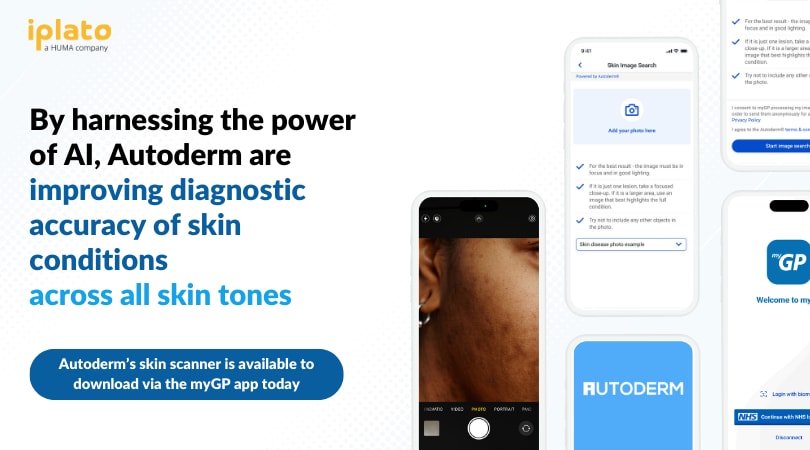
Autoderm and the myGP app, however, are changing the game! By harnessing the power of AI, Autoderm helps improve diagnostic accuracy of skin conditions across all skin tones. Their approach analyses a diverse search engine of skin images (2 million+), encompassing various ethnicities and skin tones. Their algorithm is constantly evolving and learning along with their growing bank of images. Irrespective of skin tone, myGP users can use the tech to get likely answers quickly, easily and choose how to act on the insight.


© 2026 iPLATO. All rights reserved
Practice Area
/
Making skin health accessible for all: unveiling the challenges in diagnosing skin conditions on darker skin
Women power usage and uptake of myGP®
September 23, 2017
The skin is the largest organ of the human body and acts as a protective barrier between the external environment and the inside of the body, shielding the internal organs against heat, light, injury and infection. Yet, the journey to diagnose skin conditions, especially on darker skin tones, can be challenging and not well mapped. In a recent study, physicians were presented with 364 images spanning 46 skin diseases and asked to submit up to four differential diagnoses. The physicians were four percentage points less accurate for the diagnosis of images of dark skin as compared to light skin.
Inherent biases deeply rooted in medical research, literature, and education have led to a healthcare landscape skewed towards lighter skin, often leaving behind those with darker complexions. Doctors diagnose around one-quarter of melanoma cases in Black people when cancer has already spread to nearby lymph nodes. However, amidst these challenges, there are technological advancements, such as AI, that are helping to rectify this imbalance. In May 2024, Autoderm conducted a total of 18,359 analyses through the myGP app and identified 79 cases of melanoma. This equates to about 2-3 melanoma diagnoses per day. Given that approximately 46 melanomas are diagnosed daily across the UK, the cases detected via the myGP app represent about 5% of the total daily melanoma diagnoses in the UK population.
We recognise the need for equitable healthcare solutions for all. Through our partnership with Autoderm, launched in 2023 after years of clinical and AI research, are proud to offer their next generation skin scanner to our community of 3 million users via the myGP app.
The bias in dermatology towards lighter skin tones is a well-documented issue. From medical textbooks to research studies, most visual references and diagnostic criteria are based on observations of mainly fair-skinned individuals.This bias perpetuates a cycle of misdiagnosis and inadequate treatment for patients with darker skin, which can lead to unnecessary distress and prolonged health issues such as increased itching, dryness, skin thickening and hyperpigmentation.
Autoderm and the myGP app, however, are changing the game! By harnessing the power of AI, Autoderm helps improve diagnostic accuracy of skin conditions across all skin tones. Their approach analyses a diverse search engine of skin images (2 million+), encompassing various ethnicities and skin tones. Their algorithm is constantly evolving and learning along with their growing bank of images. Irrespective of skin tone, myGP users can use the tech to get likely answers quickly, easily and choose how to act on the insight.
© 2026 iPLATO. All rights reserved
Women power usage and uptake of myGP®
September 23, 2017

New data from leading health tech specialist, iPLATO Healthcare, has revealed that women are driving uptake and usage of smartphone apps to access health services in the UK. The company has analysed recent activity on myGP and found that women are responsible for 68% of all GP appointments booked on the app. myGP is currently the most downloaded medical app on Apple and it is also available on Google Store for patients whose GP surgery is enrolled with iPLATO.
Further research shows that 62% of myGP users with medication reminders are women. In addition to using the app to support their medication needs and to book appointments for themselves, women were also more likely to take advantage of core myGP functionality such as registering as carers for dependants – mostly children but also partners and elderly parents – which allows them to book GP appointments for them, too. Almost 9 in ten of the registered carers on myGP are women.
The research suggest that more women are working and finding themselves in a position where they provide at least some level of care or support to not only their immediate family, but also to an elderly parent or disabled relative. With fewer ‘stay at home’ mums, working women are now turning to myGP as a way of managing their families’ healthcare remotely – 52% of dependents added to the app are under the age of five.
Today, around 3.7 million UK women are carers and this is anticipated to rise to 5.2 million by 2037. It is also anticipated that there will be a rise in multi-generational caring also known as ‘sandwich carers’, with currently over 2.4 million people in the UK, caring for both young children and an older or disabled relative. Increases in life expectancy coupled with delays in starting a family mean that more women are finding themselves with dual demands on their time and energy – looking after both parents and children alike.
Recently, David Mowat, the Parliamentary Undersecretary of State for Care and Support, made headlines with his comments that families should give as much support to elderly parents as they do to children. In response, Professor Alan Walker, Director of the New Dynamics of Ageing Programme said; “Community care is a myth: care for older people is overwhelmingly self-care and family care. And the fact that carers are predominantly – by a ratio of two to one – adult daughters and daughters-in-law makes this a major case of gender discrimination.”
Lemarie Moses, Product Manager of myGP comments,
“We are incredibly excited about the ability of myGP to really make a difference to the lives of families across the UK. Our recent data analysis shows an emerging trend of women harnessing tech to cope with and manage their busy day-to-day lives. As a working parent, I understand the difficulties of finding the time to manage the healthcare of your children, as well as staying on top of your own. The wonderful thing about myGP is that it makes manage your families care so simple and hassle free.”
The strength of myGP lies in its simplicity and ease of use, from the registration process through to accessing online patient services. Patients can register remotely with just their date of birth and the mobile number registered with their GP practice. In just a few seconds, they are then ready to go with secure functionality, appointment management, medication reminders and self-care tools.
© 2026 iPLATO. All rights reserved