
/
Making skin health accessible for all: unveiling the challenges in diagnosing skin conditions on darker skin
What happens when Accubook funding stops?
June 25, 2024
The skin is the largest organ of the human body and acts as a protective barrier between the external environment and the inside of the body, shielding the internal organs against heat, light, injury and infection. Yet, the journey to diagnose skin conditions, especially on darker skin tones, can be challenging and not well mapped. In a recent study, physicians were presented with 364 images spanning 46 skin diseases and asked to submit up to four differential diagnoses. The physicians were four percentage points less accurate for the diagnosis of images of dark skin as compared to light skin.
Inherent biases deeply rooted in medical research, literature, and education have led to a healthcare landscape skewed towards lighter skin, often leaving behind those with darker complexions. Doctors diagnose around one-quarter of melanoma cases in Black people when cancer has already spread to nearby lymph nodes. However, amidst these challenges, there are technological advancements, such as AI, that are helping to rectify this imbalance. In May 2024, Autoderm conducted a total of 18,359 analyses through the myGP app and identified 79 cases of melanoma. This equates to about 2-3 melanoma diagnoses per day. Given that approximately 46 melanomas are diagnosed daily across the UK, the cases detected via the myGP app represent about 5% of the total daily melanoma diagnoses in the UK population.
We recognise the need for equitable healthcare solutions for all. Through our partnership with Autoderm, launched in 2023 after years of clinical and AI research, are proud to offer their next generation skin scanner to our community of 3 million users via the myGP app.
The bias in dermatology towards lighter skin tones is a well-documented issue. From medical textbooks to research studies, most visual references and diagnostic criteria are based on observations of mainly fair-skinned individuals.This bias perpetuates a cycle of misdiagnosis and inadequate treatment for patients with darker skin, which can lead to unnecessary distress and prolonged health issues such as increased itching, dryness, skin thickening and hyperpigmentation.
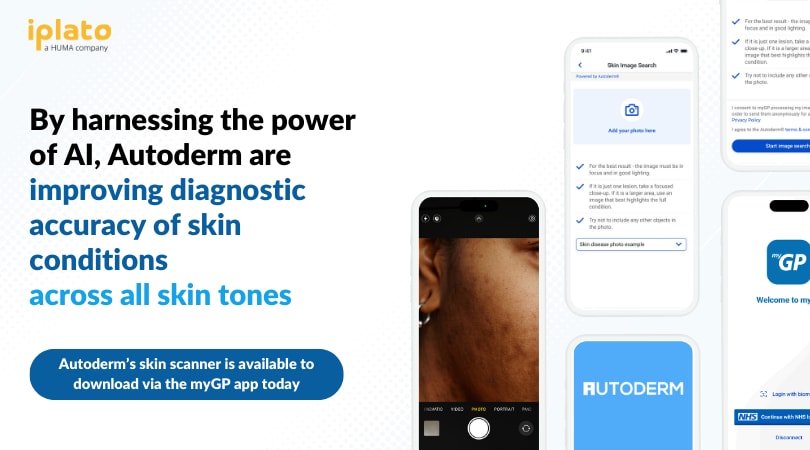
Autoderm and the myGP app, however, are changing the game! By harnessing the power of AI, Autoderm helps improve diagnostic accuracy of skin conditions across all skin tones. Their approach analyses a diverse search engine of skin images (2 million+), encompassing various ethnicities and skin tones. Their algorithm is constantly evolving and learning along with their growing bank of images. Irrespective of skin tone, myGP users can use the tech to get likely answers quickly, easily and choose how to act on the insight.


© 2026 iPLATO. All rights reserved
Practice Area
/
Making skin health accessible for all: unveiling the challenges in diagnosing skin conditions on darker skin
What happens when Accubook funding stops?
June 25, 2024
The skin is the largest organ of the human body and acts as a protective barrier between the external environment and the inside of the body, shielding the internal organs against heat, light, injury and infection. Yet, the journey to diagnose skin conditions, especially on darker skin tones, can be challenging and not well mapped. In a recent study, physicians were presented with 364 images spanning 46 skin diseases and asked to submit up to four differential diagnoses. The physicians were four percentage points less accurate for the diagnosis of images of dark skin as compared to light skin.
Inherent biases deeply rooted in medical research, literature, and education have led to a healthcare landscape skewed towards lighter skin, often leaving behind those with darker complexions. Doctors diagnose around one-quarter of melanoma cases in Black people when cancer has already spread to nearby lymph nodes. However, amidst these challenges, there are technological advancements, such as AI, that are helping to rectify this imbalance. In May 2024, Autoderm conducted a total of 18,359 analyses through the myGP app and identified 79 cases of melanoma. This equates to about 2-3 melanoma diagnoses per day. Given that approximately 46 melanomas are diagnosed daily across the UK, the cases detected via the myGP app represent about 5% of the total daily melanoma diagnoses in the UK population.
We recognise the need for equitable healthcare solutions for all. Through our partnership with Autoderm, launched in 2023 after years of clinical and AI research, are proud to offer their next generation skin scanner to our community of 3 million users via the myGP app.
The bias in dermatology towards lighter skin tones is a well-documented issue. From medical textbooks to research studies, most visual references and diagnostic criteria are based on observations of mainly fair-skinned individuals.This bias perpetuates a cycle of misdiagnosis and inadequate treatment for patients with darker skin, which can lead to unnecessary distress and prolonged health issues such as increased itching, dryness, skin thickening and hyperpigmentation.
Autoderm and the myGP app, however, are changing the game! By harnessing the power of AI, Autoderm helps improve diagnostic accuracy of skin conditions across all skin tones. Their approach analyses a diverse search engine of skin images (2 million+), encompassing various ethnicities and skin tones. Their algorithm is constantly evolving and learning along with their growing bank of images. Irrespective of skin tone, myGP users can use the tech to get likely answers quickly, easily and choose how to act on the insight.
© 2026 iPLATO. All rights reserved
What happens when Accubook funding stops?
June 25, 2024
With the expiration of the National Accubook contract on 30th June, it’s the perfect time to explore new, innovative solutions that enhance practice management and patient satisfaction. At iPLATO, we are proud to introduce iPLATO’s Selfbook product, tailored to meet the needs of Practices and Primary Care Networks (PCNs).
What is iPLATO Selfbook?
For those looking for an alternative to Accubook, iPLATO’s Selfbook offers a seamless web booking experience that integrates perfectly with existing iPLATO solutions, such as Triage and Patient Questionnaires. This enables practices to provide tailored appointments based on specific patient interactions or outcomes, such as scheduling an HbA1c immediately after an Annual Diabetes Review Questionnaire or sending a PHQ9 after receiving an online consultation request.
The benefits of using iPLATO Selfbook include:
- Simplified management: Selfbook centralises appointment availability across various sites, improving resource allocation and scheduling efficiency.
- Flexible communication: Allows sending of appointment reminders and confirmations through the Smart Gateway: the NHS App, SMS and myGP app
- Increased accessibility: Enables patients to effortlessly select their preferred location and time, adding convenience to their experience.
- Reduced no-show rates: Sends up to three automated reminders per appointment, significantly cutting down on missed appointments.
- Customisable features: Practices can invite specific patients for specific types of appointments and personalise slot names to make them more patient-friendly.
How does iPLATO Selfbook work?
Our continued focus on simplicity has delivered a process that couldn’t be easier:
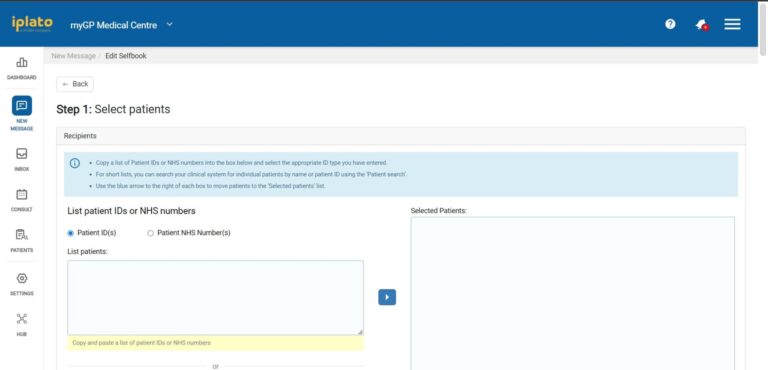
In the Side Navigation, simply click on New Message > New Selfbook
Then:
- Select your recipients
- Compose your message
- Select your slot type and additional configurable options, such as scheduling and clinical coding.
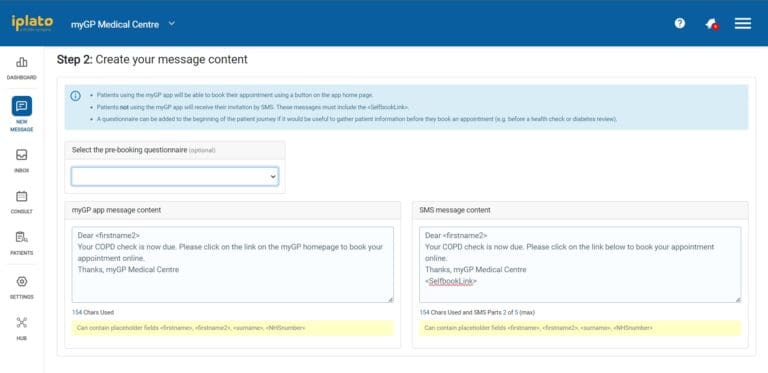
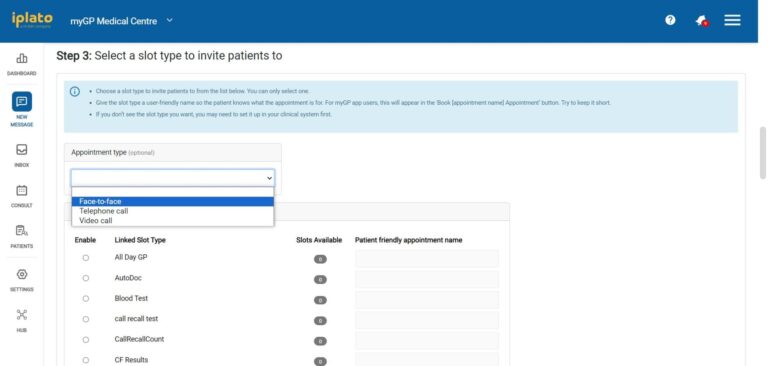
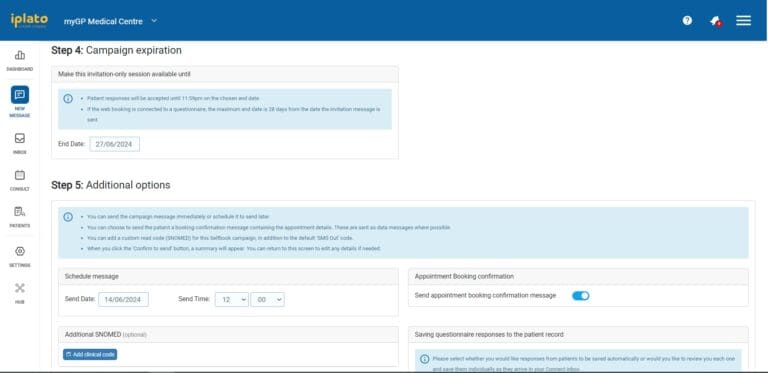
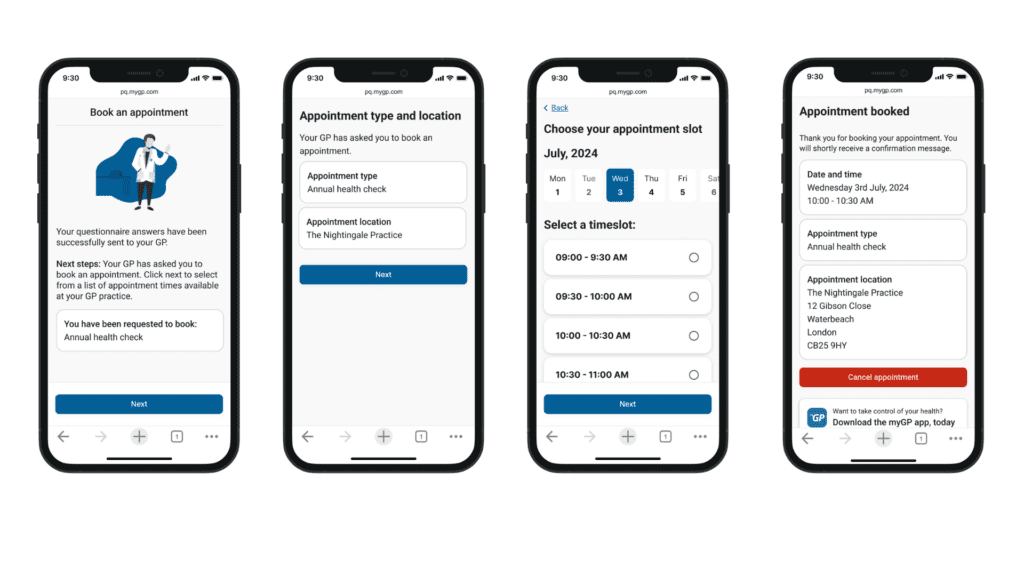
Here’s what the patient sees:
Getting started quickly to avoid paying high fees:
Already an iPLATO platform customer? Great. It’s simple as you already have access to iPLATO Selfbook. If you’re having difficulty using Selfbook, reach out to help@iplato.com
Not a customer: Looking for a quick to get started and cost-effective alternative? At 10p per patient, iPLATO Selfbook can be funded using PCARP money and reimbursed by NHSE. iPLATO Selfbook includes free of charge Appointment Reminder messages.
- Send an email request to sales@iplato.com to start the process
- Complete your practice registration form (it takes 5 minutes)
- The iPLATO Support team will do the technical background set up and share help guides
- Access online training support and best practice guides
© 2026 iPLATO. All rights reserved