

/
Making skin health accessible for all: unveiling the challenges in diagnosing skin conditions on darker skin
Two of the country’s leading care home providers pave the way with myGP TICKet proof of vaccination technology
March 24, 2021
The skin is the largest organ of the human body and acts as a protective barrier between the external environment and the inside of the body, shielding the internal organs against heat, light, injury and infection. Yet, the journey to diagnose skin conditions, especially on darker skin tones, can be challenging and not well mapped. In a recent study, physicians were presented with 364 images spanning 46 skin diseases and asked to submit up to four differential diagnoses. The physicians were four percentage points less accurate for the diagnosis of images of dark skin as compared to light skin.
Inherent biases deeply rooted in medical research, literature, and education have led to a healthcare landscape skewed towards lighter skin, often leaving behind those with darker complexions. Doctors diagnose around one-quarter of melanoma cases in Black people when cancer has already spread to nearby lymph nodes. However, amidst these challenges, there are technological advancements, such as AI, that are helping to rectify this imbalance. In May 2024, Autoderm conducted a total of 18,359 analyses through the myGP app and identified 79 cases of melanoma. This equates to about 2-3 melanoma diagnoses per day. Given that approximately 46 melanomas are diagnosed daily across the UK, the cases detected via the myGP app represent about 5% of the total daily melanoma diagnoses in the UK population.
We recognise the need for equitable healthcare solutions for all. Through our partnership with Autoderm, launched in 2023 after years of clinical and AI research, are proud to offer their next generation skin scanner to our community of 3 million users via the myGP app.
The bias in dermatology towards lighter skin tones is a well-documented issue. From medical textbooks to research studies, most visual references and diagnostic criteria are based on observations of mainly fair-skinned individuals.This bias perpetuates a cycle of misdiagnosis and inadequate treatment for patients with darker skin, which can lead to unnecessary distress and prolonged health issues such as increased itching, dryness, skin thickening and hyperpigmentation.
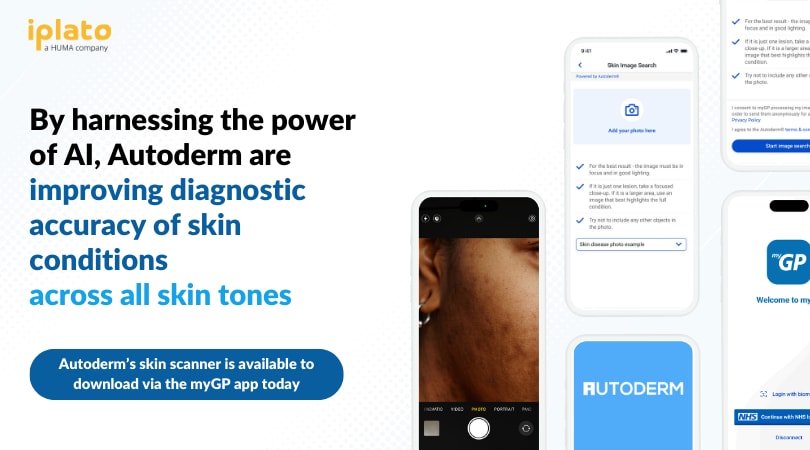
Autoderm and the myGP app, however, are changing the game! By harnessing the power of AI, Autoderm helps improve diagnostic accuracy of skin conditions across all skin tones. Their approach analyses a diverse search engine of skin images (2 million+), encompassing various ethnicities and skin tones. Their algorithm is constantly evolving and learning along with their growing bank of images. Irrespective of skin tone, myGP users can use the tech to get likely answers quickly, easily and choose how to act on the insight.


© 2026 iPLATO. All rights reserved
Practice Area
/
Making skin health accessible for all: unveiling the challenges in diagnosing skin conditions on darker skin
Two of the country’s leading care home providers pave the way with myGP TICKet proof of vaccination technology
March 24, 2021
The skin is the largest organ of the human body and acts as a protective barrier between the external environment and the inside of the body, shielding the internal organs against heat, light, injury and infection. Yet, the journey to diagnose skin conditions, especially on darker skin tones, can be challenging and not well mapped. In a recent study, physicians were presented with 364 images spanning 46 skin diseases and asked to submit up to four differential diagnoses. The physicians were four percentage points less accurate for the diagnosis of images of dark skin as compared to light skin.
Inherent biases deeply rooted in medical research, literature, and education have led to a healthcare landscape skewed towards lighter skin, often leaving behind those with darker complexions. Doctors diagnose around one-quarter of melanoma cases in Black people when cancer has already spread to nearby lymph nodes. However, amidst these challenges, there are technological advancements, such as AI, that are helping to rectify this imbalance. In May 2024, Autoderm conducted a total of 18,359 analyses through the myGP app and identified 79 cases of melanoma. This equates to about 2-3 melanoma diagnoses per day. Given that approximately 46 melanomas are diagnosed daily across the UK, the cases detected via the myGP app represent about 5% of the total daily melanoma diagnoses in the UK population.
We recognise the need for equitable healthcare solutions for all. Through our partnership with Autoderm, launched in 2023 after years of clinical and AI research, are proud to offer their next generation skin scanner to our community of 3 million users via the myGP app.
The bias in dermatology towards lighter skin tones is a well-documented issue. From medical textbooks to research studies, most visual references and diagnostic criteria are based on observations of mainly fair-skinned individuals.This bias perpetuates a cycle of misdiagnosis and inadequate treatment for patients with darker skin, which can lead to unnecessary distress and prolonged health issues such as increased itching, dryness, skin thickening and hyperpigmentation.
Autoderm and the myGP app, however, are changing the game! By harnessing the power of AI, Autoderm helps improve diagnostic accuracy of skin conditions across all skin tones. Their approach analyses a diverse search engine of skin images (2 million+), encompassing various ethnicities and skin tones. Their algorithm is constantly evolving and learning along with their growing bank of images. Irrespective of skin tone, myGP users can use the tech to get likely answers quickly, easily and choose how to act on the insight.
© 2026 iPLATO. All rights reserved
/
Two of the country’s leading care home providers pave the way with myGP TICKet proof of vaccination technology
Two of the country’s leading care home providers pave the way with myGP TICKet proof of vaccination technology
March 24, 2021
- myGP TICKet is being piloted for use in a care home setting in England
- Barchester Healthcare and Lillian Faithful care homes will be piloting the technology with staff across England
The UK’s largest independent healthcare management app, myGP, is releasing England’s first vaccine verification feature within their app next month. The myGP TICKet feature – which will enable anyone in England who is registered with a GP to communicate their vaccination status, simply and securely, via their smartphone – is being piloted next week with care homes across the UK, including the 2nd largest private care home group, Barchester Healthcare, and Lillian Faithful, a care home charity based in Cheltenham and Stroud. The myGP TICKet feature will act as a clinically assured means of proving vaccination status, displayed in real-time, generated directly from a patient’s NHS medical record.
Both care homes are trialling the feature to help better understand the vaccination status of their employees as England treads through the roadmap set out by The Prime Minister.
A recent YouGov survey stated that two thirds of Britons are in favour of vaccination passports, with 72% of them agreeing that they should be required to visit a care home. The myGP TICKet feature – which will be publicly available next month, following the completion of the pilot trials – is an obvious choice for care homes and other health and care facilities who need to ensure the safety of their residents, staff and visitors.
Simon McCall, Commercial Director of Barchester Healthcare, who are among the first to mandate vaccination for all employees, comments: Given that our residents fall primarily in the highest risk group for COVID-19, it would be irresponsible of us not to mandate vaccination for those employees for whom it is medically safe. We have a duty of care to our residents and service users that we take very seriously and are keen to find a solution that can show vaccination status quickly and securely via your phone, and the fact that the myGP app has NHS assurance makes this the most obvious choice for us to pilot to understand better. We want our staff to understand the benefits of the vaccine and we have been working hard to better educate them on what this could mean for them, and for our residents.”
Due to the vulnerability of residents, care homes were the first priority group for receiving the vaccination in England, resulting in 95% of care homes having had all their residents vaccinated[i]. However, last month, Health Secretary Matt Hancock was on record stating that almost a third of social care staff in England had not yet been vaccinated.
Discussing vaccine uptake, Martin Hughes, CEO of Lillian Faithful Care adds “As a care home group we’re very enthusiastic about trialling new technology, so we are delighted to be piloting the myGP TICKet with a few of our staff. We believe this app will help in the future with streamlining our visit process and also help our staff travel smoothly whilst on their holidays. By Tuesday 23 March, over 200 of our care home residents will have been offered and received both vaccinations, protecting them from Covid-19. With this protection, care home visits back on, our adult day care hubs re-open and now being part of this pilot – we’re on track to a brighter 2021 for our residents, staff and families.”
Indeed, the feature has broad use cases, including domestic and foreign travel, socialising, return-to-work schemes for indoor environments. It is anticipated that the introduction of this feature will also reduce the burden on NHS GP practices, who otherwise might be inundated with requests for vaccination certifications as people begin to return to everyday life around the country.
Hillary Cannon, Director of the myGP TICKet initiative at iPLATO Healthcare, comments on why it could be a game-changer for people in England: “We couldn’t be prouder to be England’s first provider of vaccine verification or to pilot this technology within care home settings. Our elderly relatives have been shielding such a long time and, now that many are receiving their second dose, it’s we are delighted to be of some help in bringing a sense of ‘normal back into their lives. We hope that these pilot schemes will pave the way for vaccination verification to become best practice within a care setting and beyond, as we are very much of the opinion that vaccination is the safest possible way to bring British business back from lockdown. We are in a number of discussions with business leaders from the hospitality, sport, and events sectors to determine how we might be able to help them safely return to at-capacity events as well.”
myGP is developed by Hammersmith-based iPLATO Healthcare. Currently assured by the NHS to give 97 percent of patients in England access to their own medical records – a service already accessed by more than 2 million patients in England. It also allows patients to request and book GP appointments, track their weight, request repeat prescriptions, and access other complementary healthcare services, such as online therapy, physiotherapy, nutrition and weight management support, virtual diagnostics, and more.
Full roll-out of myGP TICKet is due in April. NHS patients can register to be notified when the technology is live, here: www.myGP.com/ticket.
Businesses owners interested in using the new feature can email mygpticket@mygp.com to request a meeting and for further information.
© 2026 iPLATO. All rights reserved