
/
Making skin health accessible for all: unveiling the challenges in diagnosing skin conditions on darker skin
Transforming Scottish Primary Care: Reflections from SNUG 2024
December 6, 2024
The skin is the largest organ of the human body and acts as a protective barrier between the external environment and the inside of the body, shielding the internal organs against heat, light, injury and infection. Yet, the journey to diagnose skin conditions, especially on darker skin tones, can be challenging and not well mapped. In a recent study, physicians were presented with 364 images spanning 46 skin diseases and asked to submit up to four differential diagnoses. The physicians were four percentage points less accurate for the diagnosis of images of dark skin as compared to light skin.
Inherent biases deeply rooted in medical research, literature, and education have led to a healthcare landscape skewed towards lighter skin, often leaving behind those with darker complexions. Doctors diagnose around one-quarter of melanoma cases in Black people when cancer has already spread to nearby lymph nodes. However, amidst these challenges, there are technological advancements, such as AI, that are helping to rectify this imbalance. In May 2024, Autoderm conducted a total of 18,359 analyses through the myGP app and identified 79 cases of melanoma. This equates to about 2-3 melanoma diagnoses per day. Given that approximately 46 melanomas are diagnosed daily across the UK, the cases detected via the myGP app represent about 5% of the total daily melanoma diagnoses in the UK population.
We recognise the need for equitable healthcare solutions for all. Through our partnership with Autoderm, launched in 2023 after years of clinical and AI research, are proud to offer their next generation skin scanner to our community of 3 million users via the myGP app.
The bias in dermatology towards lighter skin tones is a well-documented issue. From medical textbooks to research studies, most visual references and diagnostic criteria are based on observations of mainly fair-skinned individuals.This bias perpetuates a cycle of misdiagnosis and inadequate treatment for patients with darker skin, which can lead to unnecessary distress and prolonged health issues such as increased itching, dryness, skin thickening and hyperpigmentation.
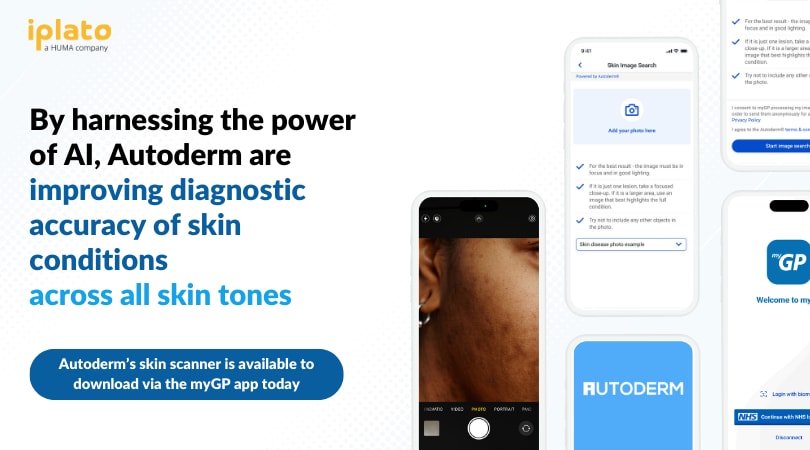
Autoderm and the myGP app, however, are changing the game! By harnessing the power of AI, Autoderm helps improve diagnostic accuracy of skin conditions across all skin tones. Their approach analyses a diverse search engine of skin images (2 million+), encompassing various ethnicities and skin tones. Their algorithm is constantly evolving and learning along with their growing bank of images. Irrespective of skin tone, myGP users can use the tech to get likely answers quickly, easily and choose how to act on the insight.


© 2026 iPLATO. All rights reserved
Practice Area
/
Making skin health accessible for all: unveiling the challenges in diagnosing skin conditions on darker skin
Transforming Scottish Primary Care: Reflections from SNUG 2024
December 6, 2024
The skin is the largest organ of the human body and acts as a protective barrier between the external environment and the inside of the body, shielding the internal organs against heat, light, injury and infection. Yet, the journey to diagnose skin conditions, especially on darker skin tones, can be challenging and not well mapped. In a recent study, physicians were presented with 364 images spanning 46 skin diseases and asked to submit up to four differential diagnoses. The physicians were four percentage points less accurate for the diagnosis of images of dark skin as compared to light skin.
Inherent biases deeply rooted in medical research, literature, and education have led to a healthcare landscape skewed towards lighter skin, often leaving behind those with darker complexions. Doctors diagnose around one-quarter of melanoma cases in Black people when cancer has already spread to nearby lymph nodes. However, amidst these challenges, there are technological advancements, such as AI, that are helping to rectify this imbalance. In May 2024, Autoderm conducted a total of 18,359 analyses through the myGP app and identified 79 cases of melanoma. This equates to about 2-3 melanoma diagnoses per day. Given that approximately 46 melanomas are diagnosed daily across the UK, the cases detected via the myGP app represent about 5% of the total daily melanoma diagnoses in the UK population.
We recognise the need for equitable healthcare solutions for all. Through our partnership with Autoderm, launched in 2023 after years of clinical and AI research, are proud to offer their next generation skin scanner to our community of 3 million users via the myGP app.
The bias in dermatology towards lighter skin tones is a well-documented issue. From medical textbooks to research studies, most visual references and diagnostic criteria are based on observations of mainly fair-skinned individuals.This bias perpetuates a cycle of misdiagnosis and inadequate treatment for patients with darker skin, which can lead to unnecessary distress and prolonged health issues such as increased itching, dryness, skin thickening and hyperpigmentation.
Autoderm and the myGP app, however, are changing the game! By harnessing the power of AI, Autoderm helps improve diagnostic accuracy of skin conditions across all skin tones. Their approach analyses a diverse search engine of skin images (2 million+), encompassing various ethnicities and skin tones. Their algorithm is constantly evolving and learning along with their growing bank of images. Irrespective of skin tone, myGP users can use the tech to get likely answers quickly, easily and choose how to act on the insight.
© 2026 iPLATO. All rights reserved
Transforming Scottish Primary Care: Reflections from SNUG 2024
December 6, 2024

By Barrie Holding, NHS Partner Manager at iPLATO, Nati Shoa, Sales Manager at eConsult and Laura Perring, Customer Success Manager at eConsult
Last week, we had the privilege of representing iPLATO and eConsult at the Scottish National Users Group (SNUG) event. At this year’s event we focused on the challenges and opportunities of digitising patient pathways—a topic we are passionate about as we strive to equip general practices with the tools they need to provide more effective and efficient care.
Our joint workshop session, “Digitising Patient Pathways” was a highlight for us. Together, we explored how the combined expertise of iPLATO and eConsult is reshaping patient pathways across Scotland. From automating communications to enabling AI-powered health tracking, we showcased how digital tools can create a more streamlined, patient-centric approach to healthcare.
Challenges in Scottish Primary care
Scotland’s primary care sector, like England and Wales’, is facing significant hurdles:
- High patient demand: Rising chronic disease prevalence and aging populations are stretching resources thin.
- Inefficient workflows: Many practices still rely on manual processes that contribute to inefficiencies and burnout.
eConsult has a strong presence in Scotland, having been used by approximately 1.5 million patients while, having been used by approximately 1.5 million patients while, on the other hand, iPLATO is gaining ground, and fast. With a comprehensive number of iPLATO products working in Scotland, such as Bulk Messaging, Selfbook, Appointment Reminders and Patient Questionnaires, iPLATO and eConsult are leaders in the market.
Our products have demonstrated tangible success in real-world settings, including areas with similar challenges to Scotland. For example, NHS practices using iPLATO Connect+ have reported significant time and cost savings. In one region, sending appointment reminders through the platform in 2023 led to 7,891 cancellations. With the average cost of a GP appointment being £42*, this helped save £331,422. These cancellations also freed up around 1,184 hours—or roughly 49 days of clinician time—enabling practices to redirect resources to patients who needed care the most. This level of efficiency could deliver comparable benefits to Scottish practices, where addressing patient demand and optimising resources are key priorities.
Founded and led by NHS clinicians, eConsult is the most widely used form-based digital asynchronous consultation and triage platform in the UK. eConsult captures over 100 common clinical conditions, with in-built red flags to identify and redirect patients presenting with urgent and emergency symptoms and highlight symptoms that may require priority review. Patients are also presented with administrative, self-help and signposting options to help drive lower acuity demand away from practices.
Over the last year, across Scotland alone, there have been over 900,000 eConsults submitted, leading to an estimated 500,000 appointments being saved!
“Demand for care from within the community is increasing every day. Our challenge is to find ways of delivering more interactions with no extra funding. e-Consult has enhanced our patient access by offering a digital route to access our services, meaning patients have access to a quick and easy online way to get help,usually without needing a face to face appointment, freeing up their time… and ours.”– Stephanie Parnell, Practice Manager (North Surgery, Annan)
What we covered at SNUG
Our session tackled real-world solutions to these challenges, demonstrating how our innovative technologies can drive meaningful change. By automating patient communications, practices can save valuable time with features like automated appointment reminders, test results notifications, and health check invitations. This reduces no-shows, improves patient compliance, and requires minimal administrative effort.
Through digitised consultations, patients can submit symptoms online 24/7 using eConsult’s Triage, alleviating phone bottlenecks and improving triage accuracy. This allows clinicians to prioritise care effectively while enhancing overall efficiency. Additionally, both iPLATO and eConsult help in reducing practice phone calls by streamlining patient interactions, freeing up staff to focus on other critical tasks.
For chronic disease management, online appointment booking simplifies care pathways, making it easier for patients to access reviews, follow-ups, and ongoing care. Meanwhile, AI advancements and patient health tracking tools monitor patient progress, flag potential health risks, and support early intervention. We also introduced Huma Intelligence, an AI-powered tool designed to enhance the quality of patient messaging while reducing SMS costs. Initial trials have shown a 20% reduction in SMS expenses, enabling practices to maximise their budgets without compromising communication quality.
Reflections from the event
We were struck by the energy and passion of the attendees. Scottish primary care professionals are clearly ready to embrace digital innovation, but there’s a recognition that adoption must align with the realities of clinical workloads and patient needs.
While eConsult is already a trusted name in Scotland, it was exciting to introduce iPLATO Connect+ to practices that may not yet have explored its full capabilities. Attendees were particularly enthusiastic about how our solutions work together seamlessly, creating a unified experience for both patients and staff.
What’s next?
If you missed our session but are eager to learn how iPLATO and eConsult can support your practice, we’d love to hear from you. Together, we can:
- Reduce administrative burden
- Improve access for patients
- Deliver better outcomes for communities across Scotland
To get started, contact us today and take advantage of our exclusive free trial offer for SNUG attendees. Reach out to us at sales@iplato.com .
* The Kings Fund, https://www.kingsfund.org.uk/insight-and-analysis/data-and-charts/key-facts-figures-nhs
© 2026 iPLATO. All rights reserved