

/
Making skin health accessible for all: unveiling the challenges in diagnosing skin conditions on darker skin
Transforming Asthma Care: A Framework for Digitising Asthma Reviews
March 19, 2024
The skin is the largest organ of the human body and acts as a protective barrier between the external environment and the inside of the body, shielding the internal organs against heat, light, injury and infection. Yet, the journey to diagnose skin conditions, especially on darker skin tones, can be challenging and not well mapped. In a recent study, physicians were presented with 364 images spanning 46 skin diseases and asked to submit up to four differential diagnoses. The physicians were four percentage points less accurate for the diagnosis of images of dark skin as compared to light skin.
Inherent biases deeply rooted in medical research, literature, and education have led to a healthcare landscape skewed towards lighter skin, often leaving behind those with darker complexions. Doctors diagnose around one-quarter of melanoma cases in Black people when cancer has already spread to nearby lymph nodes. However, amidst these challenges, there are technological advancements, such as AI, that are helping to rectify this imbalance. In May 2024, Autoderm conducted a total of 18,359 analyses through the myGP app and identified 79 cases of melanoma. This equates to about 2-3 melanoma diagnoses per day. Given that approximately 46 melanomas are diagnosed daily across the UK, the cases detected via the myGP app represent about 5% of the total daily melanoma diagnoses in the UK population.
We recognise the need for equitable healthcare solutions for all. Through our partnership with Autoderm, launched in 2023 after years of clinical and AI research, are proud to offer their next generation skin scanner to our community of 3 million users via the myGP app.
The bias in dermatology towards lighter skin tones is a well-documented issue. From medical textbooks to research studies, most visual references and diagnostic criteria are based on observations of mainly fair-skinned individuals.This bias perpetuates a cycle of misdiagnosis and inadequate treatment for patients with darker skin, which can lead to unnecessary distress and prolonged health issues such as increased itching, dryness, skin thickening and hyperpigmentation.
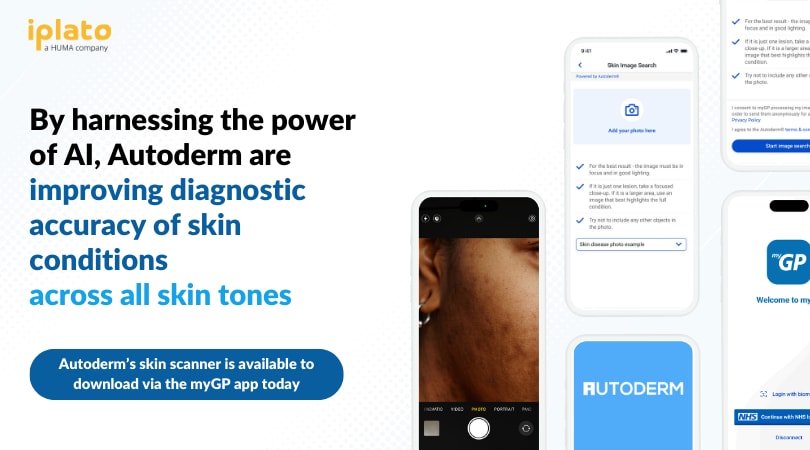
Autoderm and the myGP app, however, are changing the game! By harnessing the power of AI, Autoderm helps improve diagnostic accuracy of skin conditions across all skin tones. Their approach analyses a diverse search engine of skin images (2 million+), encompassing various ethnicities and skin tones. Their algorithm is constantly evolving and learning along with their growing bank of images. Irrespective of skin tone, myGP users can use the tech to get likely answers quickly, easily and choose how to act on the insight.


© 2026 iPLATO. All rights reserved
Practice Area
/
Making skin health accessible for all: unveiling the challenges in diagnosing skin conditions on darker skin
Transforming Asthma Care: A Framework for Digitising Asthma Reviews
March 19, 2024
The skin is the largest organ of the human body and acts as a protective barrier between the external environment and the inside of the body, shielding the internal organs against heat, light, injury and infection. Yet, the journey to diagnose skin conditions, especially on darker skin tones, can be challenging and not well mapped. In a recent study, physicians were presented with 364 images spanning 46 skin diseases and asked to submit up to four differential diagnoses. The physicians were four percentage points less accurate for the diagnosis of images of dark skin as compared to light skin.
Inherent biases deeply rooted in medical research, literature, and education have led to a healthcare landscape skewed towards lighter skin, often leaving behind those with darker complexions. Doctors diagnose around one-quarter of melanoma cases in Black people when cancer has already spread to nearby lymph nodes. However, amidst these challenges, there are technological advancements, such as AI, that are helping to rectify this imbalance. In May 2024, Autoderm conducted a total of 18,359 analyses through the myGP app and identified 79 cases of melanoma. This equates to about 2-3 melanoma diagnoses per day. Given that approximately 46 melanomas are diagnosed daily across the UK, the cases detected via the myGP app represent about 5% of the total daily melanoma diagnoses in the UK population.
We recognise the need for equitable healthcare solutions for all. Through our partnership with Autoderm, launched in 2023 after years of clinical and AI research, are proud to offer their next generation skin scanner to our community of 3 million users via the myGP app.
The bias in dermatology towards lighter skin tones is a well-documented issue. From medical textbooks to research studies, most visual references and diagnostic criteria are based on observations of mainly fair-skinned individuals.This bias perpetuates a cycle of misdiagnosis and inadequate treatment for patients with darker skin, which can lead to unnecessary distress and prolonged health issues such as increased itching, dryness, skin thickening and hyperpigmentation.
Autoderm and the myGP app, however, are changing the game! By harnessing the power of AI, Autoderm helps improve diagnostic accuracy of skin conditions across all skin tones. Their approach analyses a diverse search engine of skin images (2 million+), encompassing various ethnicities and skin tones. Their algorithm is constantly evolving and learning along with their growing bank of images. Irrespective of skin tone, myGP users can use the tech to get likely answers quickly, easily and choose how to act on the insight.
© 2026 iPLATO. All rights reserved
Transforming Asthma Care: A Framework for Digitising Asthma Reviews
March 19, 2024

Asthma, a prevalent chronic respiratory condition affecting millions globally, demands regular reviews for effective symptom management. Drawing on recent discussions, I will explore the advantages and hurdles when digitising asthma reviews, presenting an all-encompassing framework designed to elevate patient care while minimising practice pressures.
In the UK, 12% of our population is living with asthma, yet we face challenges with many missing their annual reviews. This contributes to around 60,000 hospital admissions annually, underscoring the need for more effective management to prevent these avoidable situations and lessen the burden on healthcare services.
Undoubtedly there are challenges when it comes to delivering annual asthma reviews, including…
- Clinical capacity: The primary obstacle in delivering annual asthma reviews lies in the strain on clinical capacity. The overwhelming number of patients requiring reviews can lead to delays and compromise the quality of care. GP practices can struggle to keep up to date with patient data and often do not have spare time to complete the extra administration that comes with delivering these reviews.
- Patient behaviour: No two people with asthma are the same and consequently manage their asthma differently. Non-adherence to treatment plans and missed appointments contribute to poor asthma control. Understanding and addressing patient behaviour is crucial for effective asthma reviews.
- Quality of reviews: Traditional face-to-face reviews may lack consistency and standardisation. Ensuring a high-quality review for every patient is complex, and variations in practice can impact the overall effectiveness of asthma management.
A recent pilot at iPLATO shows the positive impact of digitisation. The digital Asthma Control Test (ACT) questionnaire saw a 42% completion rate initially, with a 19% increase after reminders, highlighting the effectiveness of digital engagement. This approach not only improves patient involvement but also offers several benefits to healthcare providers.
Digitising asthma reviews has increased clinical capacity by 25%, allowing for more efficient patient management without added administrative burden. Financially, achieving the Quality and Outcomes Framework (QOF) upper thresholds has brought tangible rewards to practices, alongside saving 90 hours in clinician time, which speaks to the efficiency gains. Crucially, the digital pathway prioritises patients with poorly controlled asthma, ensuring timely interventions for those at greatest risk.
Moving towards a scalable digital-first approach in asthma reviews addresses key challenges in clinical capacity, patient behaviour, and review quality. The goal is to enhance patient outcomes and reduce unnecessary hospital admissions by embracing innovative solutions in asthma care. Crucially, this model can, and should be applied across COPD, cardiovascular and diabetes care.
In summary, digitising asthma management is a step towards more accessible, personalised, and proactive healthcare. By adopting digital tools, we can overcome traditional barriers and provide a more effective approach to asthma care.
© 2026 iPLATO. All rights reserved