
/
Making skin health accessible for all: unveiling the challenges in diagnosing skin conditions on darker skin
This World Cancer Day, myGP continues its commitment to disease prevention
February 4, 2020
The skin is the largest organ of the human body and acts as a protective barrier between the external environment and the inside of the body, shielding the internal organs against heat, light, injury and infection. Yet, the journey to diagnose skin conditions, especially on darker skin tones, can be challenging and not well mapped. In a recent study, physicians were presented with 364 images spanning 46 skin diseases and asked to submit up to four differential diagnoses. The physicians were four percentage points less accurate for the diagnosis of images of dark skin as compared to light skin.
Inherent biases deeply rooted in medical research, literature, and education have led to a healthcare landscape skewed towards lighter skin, often leaving behind those with darker complexions. Doctors diagnose around one-quarter of melanoma cases in Black people when cancer has already spread to nearby lymph nodes. However, amidst these challenges, there are technological advancements, such as AI, that are helping to rectify this imbalance. In May 2024, Autoderm conducted a total of 18,359 analyses through the myGP app and identified 79 cases of melanoma. This equates to about 2-3 melanoma diagnoses per day. Given that approximately 46 melanomas are diagnosed daily across the UK, the cases detected via the myGP app represent about 5% of the total daily melanoma diagnoses in the UK population.
We recognise the need for equitable healthcare solutions for all. Through our partnership with Autoderm, launched in 2023 after years of clinical and AI research, are proud to offer their next generation skin scanner to our community of 3 million users via the myGP app.
The bias in dermatology towards lighter skin tones is a well-documented issue. From medical textbooks to research studies, most visual references and diagnostic criteria are based on observations of mainly fair-skinned individuals.This bias perpetuates a cycle of misdiagnosis and inadequate treatment for patients with darker skin, which can lead to unnecessary distress and prolonged health issues such as increased itching, dryness, skin thickening and hyperpigmentation.
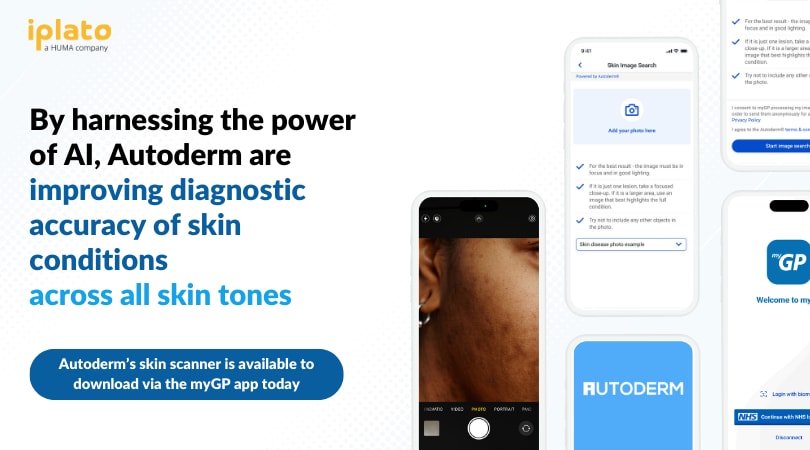
Autoderm and the myGP app, however, are changing the game! By harnessing the power of AI, Autoderm helps improve diagnostic accuracy of skin conditions across all skin tones. Their approach analyses a diverse search engine of skin images (2 million+), encompassing various ethnicities and skin tones. Their algorithm is constantly evolving and learning along with their growing bank of images. Irrespective of skin tone, myGP users can use the tech to get likely answers quickly, easily and choose how to act on the insight.


© 2026 iPLATO. All rights reserved
Practice Area
/
Making skin health accessible for all: unveiling the challenges in diagnosing skin conditions on darker skin
This World Cancer Day, myGP continues its commitment to disease prevention
February 4, 2020
The skin is the largest organ of the human body and acts as a protective barrier between the external environment and the inside of the body, shielding the internal organs against heat, light, injury and infection. Yet, the journey to diagnose skin conditions, especially on darker skin tones, can be challenging and not well mapped. In a recent study, physicians were presented with 364 images spanning 46 skin diseases and asked to submit up to four differential diagnoses. The physicians were four percentage points less accurate for the diagnosis of images of dark skin as compared to light skin.
Inherent biases deeply rooted in medical research, literature, and education have led to a healthcare landscape skewed towards lighter skin, often leaving behind those with darker complexions. Doctors diagnose around one-quarter of melanoma cases in Black people when cancer has already spread to nearby lymph nodes. However, amidst these challenges, there are technological advancements, such as AI, that are helping to rectify this imbalance. In May 2024, Autoderm conducted a total of 18,359 analyses through the myGP app and identified 79 cases of melanoma. This equates to about 2-3 melanoma diagnoses per day. Given that approximately 46 melanomas are diagnosed daily across the UK, the cases detected via the myGP app represent about 5% of the total daily melanoma diagnoses in the UK population.
We recognise the need for equitable healthcare solutions for all. Through our partnership with Autoderm, launched in 2023 after years of clinical and AI research, are proud to offer their next generation skin scanner to our community of 3 million users via the myGP app.
The bias in dermatology towards lighter skin tones is a well-documented issue. From medical textbooks to research studies, most visual references and diagnostic criteria are based on observations of mainly fair-skinned individuals.This bias perpetuates a cycle of misdiagnosis and inadequate treatment for patients with darker skin, which can lead to unnecessary distress and prolonged health issues such as increased itching, dryness, skin thickening and hyperpigmentation.
Autoderm and the myGP app, however, are changing the game! By harnessing the power of AI, Autoderm helps improve diagnostic accuracy of skin conditions across all skin tones. Their approach analyses a diverse search engine of skin images (2 million+), encompassing various ethnicities and skin tones. Their algorithm is constantly evolving and learning along with their growing bank of images. Irrespective of skin tone, myGP users can use the tech to get likely answers quickly, easily and choose how to act on the insight.
© 2026 iPLATO. All rights reserved
This World Cancer Day, myGP continues its commitment to disease prevention
February 4, 2020
We have worked with the NHS, Public Health England and a number of charitable trusts to promote the NHS disease prevention agenda, not just across cancer screening but across other screening and vaccination programmes to encourage every man, woman and child eligible to book and attend a screening or vaccination appointment.
Currently 870 women die a year from cervical cancer, however 83% of cervical cancer deaths could be avoided if all eligible women participated in cervical screening, meaning up to 722 lives could be saved a year with optimal screening uptake.
Attendance at cervical screening appointments is in decline. Over the past twenty years the number of women attending their appointments has decreased year on year – despite increased education and awareness. Currently only 1 in 3 women aged 25-29 attend their screening appointment, and this can fall to as low as 1 in 2 in deprived areas. Meaning that of the UK women eligible for cervical screening, almost 3.7 million are putting themselves at risk of life-threatening cervical cancer by not attended cervical screening within the last five years.
London has the lowest number of women attending their screening appointments in the country with only 65% of women invited for screening taking up the appointment.
Traditionally women are invited to book their screening appointment via letter sent to their home address and a new scheme rolled-out across London by Public Health England, NHS England/NHS Improvement alongside Jo’s Cervical Cancer Trust and technology provider iPLATO healthcare, supplemented this with a GP endorsed SMS reminder sent to patients.
The SMS reminder service from the company behind myGP. iPLATO, has yielded fantastic results, over a 18 week period last year 13000 more women were screened – and he SMS reminder service has been highly praised by The Government and has been recommended for both screening and vaccinations – leading the way in cost effective technologies to assist the aid prevention agenda.
Jo’s Cervical Cancer Trust undertook a range of research projects to understand the barriers in place preventing women from attending their screening. Awareness of cervical screening is lowest in the Black, Asian and Ethnic Minority backgrounds, with differing levels of understanding and recognition of the term ‘cervical screening’ or ‘smear test’, a third more BAME woman than white woman said they have never attended screening with 30% of Asian women claimed they did not know what cervical screening is.
There is a worrying downward trend in women aged over 50 attending their screening appointment with 31% not considering it necessary, even though this is the age group most likely to be diagnosed with advance stage cervical cancer, with 49% of diagnosis being at stage two or later.
While there is still a huge education piece that needs to be done on the importance of cervical screening implementing this small change and introducing GP endorsed SMS reminders could save lives.
The NHS provides a number of disease prevention programmes across the board, including screenings programmes and vaccinations, a full list of screening available to patients on the NHS is available here.
If you’re not sure if you are due a screening or vaccination, you can view your medical record in the myGP app or contact your surgery to find if you are up to date with your screening or vaccination programmes.
We are committed to continue to simplify access to healthcare.
© 2026 iPLATO. All rights reserved