
/
Making skin health accessible for all: unveiling the challenges in diagnosing skin conditions on darker skin
This World Cancer Day – a Focus on Prevention.
February 4, 2022
The skin is the largest organ of the human body and acts as a protective barrier between the external environment and the inside of the body, shielding the internal organs against heat, light, injury and infection. Yet, the journey to diagnose skin conditions, especially on darker skin tones, can be challenging and not well mapped. In a recent study, physicians were presented with 364 images spanning 46 skin diseases and asked to submit up to four differential diagnoses. The physicians were four percentage points less accurate for the diagnosis of images of dark skin as compared to light skin.
Inherent biases deeply rooted in medical research, literature, and education have led to a healthcare landscape skewed towards lighter skin, often leaving behind those with darker complexions. Doctors diagnose around one-quarter of melanoma cases in Black people when cancer has already spread to nearby lymph nodes. However, amidst these challenges, there are technological advancements, such as AI, that are helping to rectify this imbalance. In May 2024, Autoderm conducted a total of 18,359 analyses through the myGP app and identified 79 cases of melanoma. This equates to about 2-3 melanoma diagnoses per day. Given that approximately 46 melanomas are diagnosed daily across the UK, the cases detected via the myGP app represent about 5% of the total daily melanoma diagnoses in the UK population.
We recognise the need for equitable healthcare solutions for all. Through our partnership with Autoderm, launched in 2023 after years of clinical and AI research, are proud to offer their next generation skin scanner to our community of 3 million users via the myGP app.
The bias in dermatology towards lighter skin tones is a well-documented issue. From medical textbooks to research studies, most visual references and diagnostic criteria are based on observations of mainly fair-skinned individuals.This bias perpetuates a cycle of misdiagnosis and inadequate treatment for patients with darker skin, which can lead to unnecessary distress and prolonged health issues such as increased itching, dryness, skin thickening and hyperpigmentation.
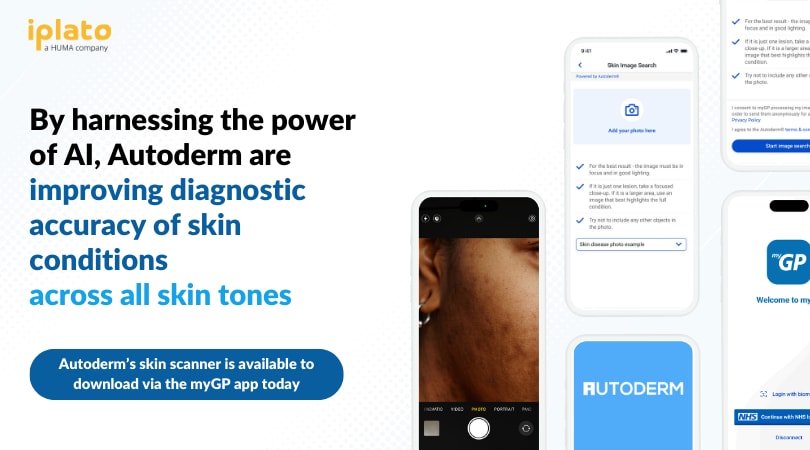
Autoderm and the myGP app, however, are changing the game! By harnessing the power of AI, Autoderm helps improve diagnostic accuracy of skin conditions across all skin tones. Their approach analyses a diverse search engine of skin images (2 million+), encompassing various ethnicities and skin tones. Their algorithm is constantly evolving and learning along with their growing bank of images. Irrespective of skin tone, myGP users can use the tech to get likely answers quickly, easily and choose how to act on the insight.


© 2026 iPLATO. All rights reserved
Practice Area
/
Making skin health accessible for all: unveiling the challenges in diagnosing skin conditions on darker skin
This World Cancer Day – a Focus on Prevention.
February 4, 2022
The skin is the largest organ of the human body and acts as a protective barrier between the external environment and the inside of the body, shielding the internal organs against heat, light, injury and infection. Yet, the journey to diagnose skin conditions, especially on darker skin tones, can be challenging and not well mapped. In a recent study, physicians were presented with 364 images spanning 46 skin diseases and asked to submit up to four differential diagnoses. The physicians were four percentage points less accurate for the diagnosis of images of dark skin as compared to light skin.
Inherent biases deeply rooted in medical research, literature, and education have led to a healthcare landscape skewed towards lighter skin, often leaving behind those with darker complexions. Doctors diagnose around one-quarter of melanoma cases in Black people when cancer has already spread to nearby lymph nodes. However, amidst these challenges, there are technological advancements, such as AI, that are helping to rectify this imbalance. In May 2024, Autoderm conducted a total of 18,359 analyses through the myGP app and identified 79 cases of melanoma. This equates to about 2-3 melanoma diagnoses per day. Given that approximately 46 melanomas are diagnosed daily across the UK, the cases detected via the myGP app represent about 5% of the total daily melanoma diagnoses in the UK population.
We recognise the need for equitable healthcare solutions for all. Through our partnership with Autoderm, launched in 2023 after years of clinical and AI research, are proud to offer their next generation skin scanner to our community of 3 million users via the myGP app.
The bias in dermatology towards lighter skin tones is a well-documented issue. From medical textbooks to research studies, most visual references and diagnostic criteria are based on observations of mainly fair-skinned individuals.This bias perpetuates a cycle of misdiagnosis and inadequate treatment for patients with darker skin, which can lead to unnecessary distress and prolonged health issues such as increased itching, dryness, skin thickening and hyperpigmentation.
Autoderm and the myGP app, however, are changing the game! By harnessing the power of AI, Autoderm helps improve diagnostic accuracy of skin conditions across all skin tones. Their approach analyses a diverse search engine of skin images (2 million+), encompassing various ethnicities and skin tones. Their algorithm is constantly evolving and learning along with their growing bank of images. Irrespective of skin tone, myGP users can use the tech to get likely answers quickly, easily and choose how to act on the insight.
© 2026 iPLATO. All rights reserved
This World Cancer Day – a Focus on Prevention.
February 4, 2022
Cancer is the second-leading cause of death worldwide, accounting for approximately 10 million deaths each year. With at least one third of common cancers being preventable, this means that millions of lives could be saved through earlier detection and treatment.
Screening programmes in England save around 10,000 lives per year through prevention and early diagnosis. Uptake of these programmes has been steadily declining and, along with the temporary pause in screening/cancer care services due to COVID-19, this has had both health and financial implications.
iPLATO has been supporting cancer screening programmes for many years using its DTAC-approved myGP Population Health Service. This service successfully delivers healthcare campaigns at scale by extracting data from patient records to centralise patient communication. Various projects implementing our multi-media driven solutions have validated our approach and shown a transformed uptake of cervical smears and improved participation in breast and bowel cancer screening services. For example, we have worked with NHS England to deliver a London-wide Cervical Screening text reminder programme, which has resulted in a 4.8% increase in attendance, equating to an extra 13,000 women being screened. Improving uptake across all age ranges and deprivation scales, this solution has also decreased the time between receiving an invitation and attending screening by 17 days on average. Further analysis has also showed an improvement on initial figures, with uptake increasing further to 6.3%.
According to Jo’s Trust, over half of the women surveyed reported delaying or not attending screening. We have worked with various areas to help reduce health inequalities by exploring reasons for non-attendance and encouraging participation in hard-to-reach groups. For example, our Breast Cancer programme deployed in South East London targeted women who missed their two previous breast screening appointments. An SMS questionnaire combined with telephone outreach enabled us to capture common reasons for non-attendance and use this feedback to inform communication strategies to encourage women to book an appointment. As a result, over one third of contactable patients were re-booked in for another appointment, equating to over 1800 patients, with 56% of non-responders attending their re-booked appointment. We have also implemented another Cervical Screening SMS programme in North Central London targeting non-responder patients. Approximately 12% of those who had never previously been screened attended their cervical screening appointment following an additional text reminder message.
As well as working to improve the uptake of screening services, our digital interventions aim to tackle health inequalities and unmet needs to raise public awareness and ultimately improve survival outcomes at scale.
We are, as ever, here to help. And that starts with helping improve the prevention of thousands of cancer-related deaths each year.
-Tara Bush
© 2026 iPLATO. All rights reserved