
/
Making skin health accessible for all: unveiling the challenges in diagnosing skin conditions on darker skin
The Intersection of Mental Health and Cancer in the UK
February 22, 2024
The skin is the largest organ of the human body and acts as a protective barrier between the external environment and the inside of the body, shielding the internal organs against heat, light, injury and infection. Yet, the journey to diagnose skin conditions, especially on darker skin tones, can be challenging and not well mapped. In a recent study, physicians were presented with 364 images spanning 46 skin diseases and asked to submit up to four differential diagnoses. The physicians were four percentage points less accurate for the diagnosis of images of dark skin as compared to light skin.
Inherent biases deeply rooted in medical research, literature, and education have led to a healthcare landscape skewed towards lighter skin, often leaving behind those with darker complexions. Doctors diagnose around one-quarter of melanoma cases in Black people when cancer has already spread to nearby lymph nodes. However, amidst these challenges, there are technological advancements, such as AI, that are helping to rectify this imbalance. In May 2024, Autoderm conducted a total of 18,359 analyses through the myGP app and identified 79 cases of melanoma. This equates to about 2-3 melanoma diagnoses per day. Given that approximately 46 melanomas are diagnosed daily across the UK, the cases detected via the myGP app represent about 5% of the total daily melanoma diagnoses in the UK population.
We recognise the need for equitable healthcare solutions for all. Through our partnership with Autoderm, launched in 2023 after years of clinical and AI research, are proud to offer their next generation skin scanner to our community of 3 million users via the myGP app.
The bias in dermatology towards lighter skin tones is a well-documented issue. From medical textbooks to research studies, most visual references and diagnostic criteria are based on observations of mainly fair-skinned individuals.This bias perpetuates a cycle of misdiagnosis and inadequate treatment for patients with darker skin, which can lead to unnecessary distress and prolonged health issues such as increased itching, dryness, skin thickening and hyperpigmentation.
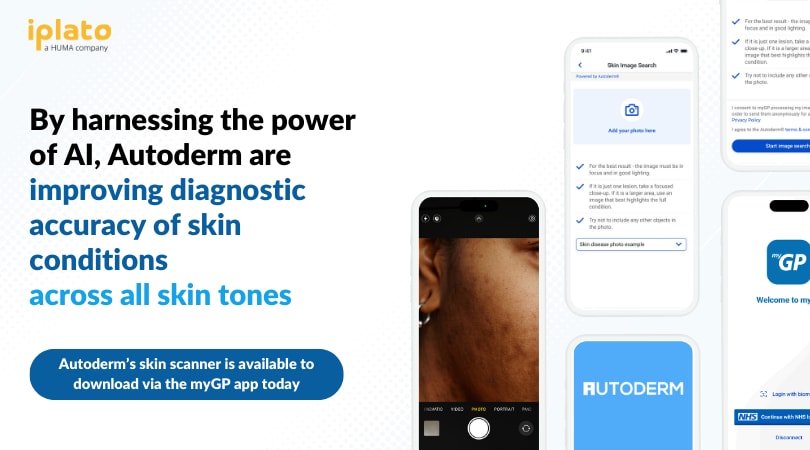
Autoderm and the myGP app, however, are changing the game! By harnessing the power of AI, Autoderm helps improve diagnostic accuracy of skin conditions across all skin tones. Their approach analyses a diverse search engine of skin images (2 million+), encompassing various ethnicities and skin tones. Their algorithm is constantly evolving and learning along with their growing bank of images. Irrespective of skin tone, myGP users can use the tech to get likely answers quickly, easily and choose how to act on the insight.


© 2026 iPLATO. All rights reserved
Practice Area
/
Making skin health accessible for all: unveiling the challenges in diagnosing skin conditions on darker skin
The Intersection of Mental Health and Cancer in the UK
February 22, 2024
The skin is the largest organ of the human body and acts as a protective barrier between the external environment and the inside of the body, shielding the internal organs against heat, light, injury and infection. Yet, the journey to diagnose skin conditions, especially on darker skin tones, can be challenging and not well mapped. In a recent study, physicians were presented with 364 images spanning 46 skin diseases and asked to submit up to four differential diagnoses. The physicians were four percentage points less accurate for the diagnosis of images of dark skin as compared to light skin.
Inherent biases deeply rooted in medical research, literature, and education have led to a healthcare landscape skewed towards lighter skin, often leaving behind those with darker complexions. Doctors diagnose around one-quarter of melanoma cases in Black people when cancer has already spread to nearby lymph nodes. However, amidst these challenges, there are technological advancements, such as AI, that are helping to rectify this imbalance. In May 2024, Autoderm conducted a total of 18,359 analyses through the myGP app and identified 79 cases of melanoma. This equates to about 2-3 melanoma diagnoses per day. Given that approximately 46 melanomas are diagnosed daily across the UK, the cases detected via the myGP app represent about 5% of the total daily melanoma diagnoses in the UK population.
We recognise the need for equitable healthcare solutions for all. Through our partnership with Autoderm, launched in 2023 after years of clinical and AI research, are proud to offer their next generation skin scanner to our community of 3 million users via the myGP app.
The bias in dermatology towards lighter skin tones is a well-documented issue. From medical textbooks to research studies, most visual references and diagnostic criteria are based on observations of mainly fair-skinned individuals.This bias perpetuates a cycle of misdiagnosis and inadequate treatment for patients with darker skin, which can lead to unnecessary distress and prolonged health issues such as increased itching, dryness, skin thickening and hyperpigmentation.
Autoderm and the myGP app, however, are changing the game! By harnessing the power of AI, Autoderm helps improve diagnostic accuracy of skin conditions across all skin tones. Their approach analyses a diverse search engine of skin images (2 million+), encompassing various ethnicities and skin tones. Their algorithm is constantly evolving and learning along with their growing bank of images. Irrespective of skin tone, myGP users can use the tech to get likely answers quickly, easily and choose how to act on the insight.
© 2026 iPLATO. All rights reserved
The Intersection of Mental Health and Cancer in the UK
February 22, 2024

According to Macmillan Cancer Support, about one-fifth of people with cancer (20%) say mental health issues such as worry, fear and anxiety have been a concerning issue because of their cancer or its treatment. The emotional toll of a cancer diagnosis can be overwhelming, affecting patients and their loved ones and can persist long after treatment.
Cancer not only poses physical challenges but also takes a toll on mental well-being. The 10 cancer targets in the NHS in England were slimmed down to just three “standards” in a move designed to speed up diagnosis times and improve cancer care. This reduction was introduced due to more than a third of cancer patients in England facing potentially fatal delays in diagnosis and treatment. Prof. Pat Price, a co-founder of the #CatchUpWithCancercampaign, commented “In December, 7,661 cancer patients waited more than the maximum recommended 62 days to start their cancer treatment, with 2,227 waiting three months or more.” It can be easy to forget that behind these numbers are real people going through an incredibly anxious time, worsened by treatment waiting times. A study in the British Medical Journal estimated that a 4-week delay to cancer surgery led to a 6-8% increased risk of dying. In this blog, we explore the crucial intersection of mental health and cancer, understanding the impact on individuals facing this diagnosis and those supporting them.
A cancer diagnosis is a life-altering experience that can leave those affected feeling fearful, anxious and even depressed. The site of primary cancer also influences rates of depression with depression being most common in pancreatic and lung cancers and lowest in invasive skin cancer. The uncertainty of the journey, coupled with the emotional strain on patients and their loved ones, underscores the importance of addressing mental health alongside medical treatments. This is especially critical considering that poor recognition of depression and anxiety is associated with a reduced quality of life and survival.
Access to Support Services:
In the UK, strides have been made in recognising the mental health needs of cancer patients. Support services, including counselling, psychotherapy, and support groups, aim to provide individuals with the emotional tools to navigate their journey. The power of digital interventions should not be underestimated when it comes to supporting patients. The Improving Access to Psychological Therapies (IAPT) programme began in 2008 with the aim of transforming the treatment of adult anxiety disorders and depression in England. At a time when patient demand for mental health services was high and GP capacity was low, iPLATO supported IAPT (Talking Therapy). Working across nine Talking Therapy Service hubs across London and Bedfordshire, deployed targeted SMS messages to drive self-referrals for IAPT services. Raising awareness of programmes like IAPT through digital interventions is crucial so that people are aware these resources are available to help them. Other mental health services for different age groups and areas, such as Kooth and Qwell are also availble on iPLATO’s myGP app. Initiatives like Macmillan Cancer Support and Mind’s resources also play a pivotal role in offering assistance beyond the medical realm.
Integrated Care:
The evolving landscape of cancer care in the UK emphasises the importance of an integrated approach that extends beyond medical treatments. In alignment with the NHS Long Term Plan, there is a focus on both cancer and mental health services. This plan aims to increase the proportion of cancers diagnosed at stages 1 and 2 from approximately half to three-quarters of all cancer patients by 2028. In terms of mental health, there has been a renewed pledge to enhance and broaden access to care for both children and adults in need of mental health support. By recognising mental health as a fundamental aspect of patient well-being, healthcare providers are advancing towards a comprehensive approach that encompasses both the physical and emotional facets of the cancer journey.
No one needs to face this battle alone. With continued advocacy and improved access to support services, combined with updated cancer target focussed on speeding up time from diagnosis to care we are optimistic about an improved future where individuals faced with a cancer diagnosis can find comprehensive care and support for both their body and mind.
© 2026 iPLATO. All rights reserved