
/
Making skin health accessible for all: unveiling the challenges in diagnosing skin conditions on darker skin
SMS reminders for cancer screenings can save lives
January 19, 2021
The skin is the largest organ of the human body and acts as a protective barrier between the external environment and the inside of the body, shielding the internal organs against heat, light, injury and infection. Yet, the journey to diagnose skin conditions, especially on darker skin tones, can be challenging and not well mapped. In a recent study, physicians were presented with 364 images spanning 46 skin diseases and asked to submit up to four differential diagnoses. The physicians were four percentage points less accurate for the diagnosis of images of dark skin as compared to light skin.
Inherent biases deeply rooted in medical research, literature, and education have led to a healthcare landscape skewed towards lighter skin, often leaving behind those with darker complexions. Doctors diagnose around one-quarter of melanoma cases in Black people when cancer has already spread to nearby lymph nodes. However, amidst these challenges, there are technological advancements, such as AI, that are helping to rectify this imbalance. In May 2024, Autoderm conducted a total of 18,359 analyses through the myGP app and identified 79 cases of melanoma. This equates to about 2-3 melanoma diagnoses per day. Given that approximately 46 melanomas are diagnosed daily across the UK, the cases detected via the myGP app represent about 5% of the total daily melanoma diagnoses in the UK population.
We recognise the need for equitable healthcare solutions for all. Through our partnership with Autoderm, launched in 2023 after years of clinical and AI research, are proud to offer their next generation skin scanner to our community of 3 million users via the myGP app.
The bias in dermatology towards lighter skin tones is a well-documented issue. From medical textbooks to research studies, most visual references and diagnostic criteria are based on observations of mainly fair-skinned individuals.This bias perpetuates a cycle of misdiagnosis and inadequate treatment for patients with darker skin, which can lead to unnecessary distress and prolonged health issues such as increased itching, dryness, skin thickening and hyperpigmentation.
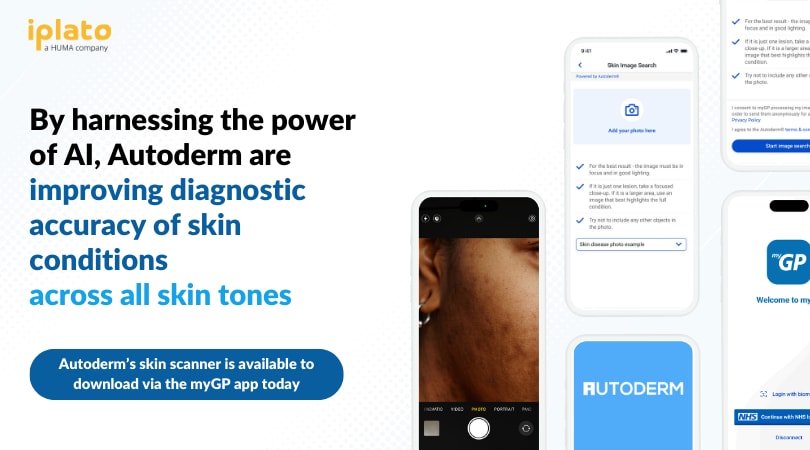
Autoderm and the myGP app, however, are changing the game! By harnessing the power of AI, Autoderm helps improve diagnostic accuracy of skin conditions across all skin tones. Their approach analyses a diverse search engine of skin images (2 million+), encompassing various ethnicities and skin tones. Their algorithm is constantly evolving and learning along with their growing bank of images. Irrespective of skin tone, myGP users can use the tech to get likely answers quickly, easily and choose how to act on the insight.


© 2026 iPLATO. All rights reserved
Practice Area
/
Making skin health accessible for all: unveiling the challenges in diagnosing skin conditions on darker skin
SMS reminders for cancer screenings can save lives
January 19, 2021
The skin is the largest organ of the human body and acts as a protective barrier between the external environment and the inside of the body, shielding the internal organs against heat, light, injury and infection. Yet, the journey to diagnose skin conditions, especially on darker skin tones, can be challenging and not well mapped. In a recent study, physicians were presented with 364 images spanning 46 skin diseases and asked to submit up to four differential diagnoses. The physicians were four percentage points less accurate for the diagnosis of images of dark skin as compared to light skin.
Inherent biases deeply rooted in medical research, literature, and education have led to a healthcare landscape skewed towards lighter skin, often leaving behind those with darker complexions. Doctors diagnose around one-quarter of melanoma cases in Black people when cancer has already spread to nearby lymph nodes. However, amidst these challenges, there are technological advancements, such as AI, that are helping to rectify this imbalance. In May 2024, Autoderm conducted a total of 18,359 analyses through the myGP app and identified 79 cases of melanoma. This equates to about 2-3 melanoma diagnoses per day. Given that approximately 46 melanomas are diagnosed daily across the UK, the cases detected via the myGP app represent about 5% of the total daily melanoma diagnoses in the UK population.
We recognise the need for equitable healthcare solutions for all. Through our partnership with Autoderm, launched in 2023 after years of clinical and AI research, are proud to offer their next generation skin scanner to our community of 3 million users via the myGP app.
The bias in dermatology towards lighter skin tones is a well-documented issue. From medical textbooks to research studies, most visual references and diagnostic criteria are based on observations of mainly fair-skinned individuals.This bias perpetuates a cycle of misdiagnosis and inadequate treatment for patients with darker skin, which can lead to unnecessary distress and prolonged health issues such as increased itching, dryness, skin thickening and hyperpigmentation.
Autoderm and the myGP app, however, are changing the game! By harnessing the power of AI, Autoderm helps improve diagnostic accuracy of skin conditions across all skin tones. Their approach analyses a diverse search engine of skin images (2 million+), encompassing various ethnicities and skin tones. Their algorithm is constantly evolving and learning along with their growing bank of images. Irrespective of skin tone, myGP users can use the tech to get likely answers quickly, easily and choose how to act on the insight.
© 2026 iPLATO. All rights reserved
SMS reminders for cancer screenings can save lives
January 19, 2021

Simple SMS reminders will see 780k more patients attending cancer screenings in the next 12 months, new campaign reveals.
A new campaign has been launched today by the UK’s largest independent healthcare management app, ‘myGP’, urging NHS England to introduce centralised SMS reminders across all national cancer screening programmes. The proposed solution, if implemented as standard across all GP practices in England, would save approximately 7,800 lives each year.[1] Currently, only 34 percent of practices can ensure their patients receive a text message reminder alongside the traditional screening invite letter.[2]
Central to the ‘Remind Us’ campaign is a petition, which acts as a public record of support for a much-needed intervention, based on recent research revealing that a simple SMS reminder can increase uptake of cancer screening by an average of 5.2 percent.[3] As the COVID-19 pandemic has caused a dramatic decrease in cancer diagnoses due to the pause put on the programmes, it is now more important than ever to encourage patients to action their invitation to screening.[4]
The current disparity between local authorities’ cancer screening rates is concerning – below is a league table of England’s most populated cities, showing those who are doing well, and those who are struggling. The percentage is based on an average across the three main cancer screening programmes – breast, bowel and cervical.[i]
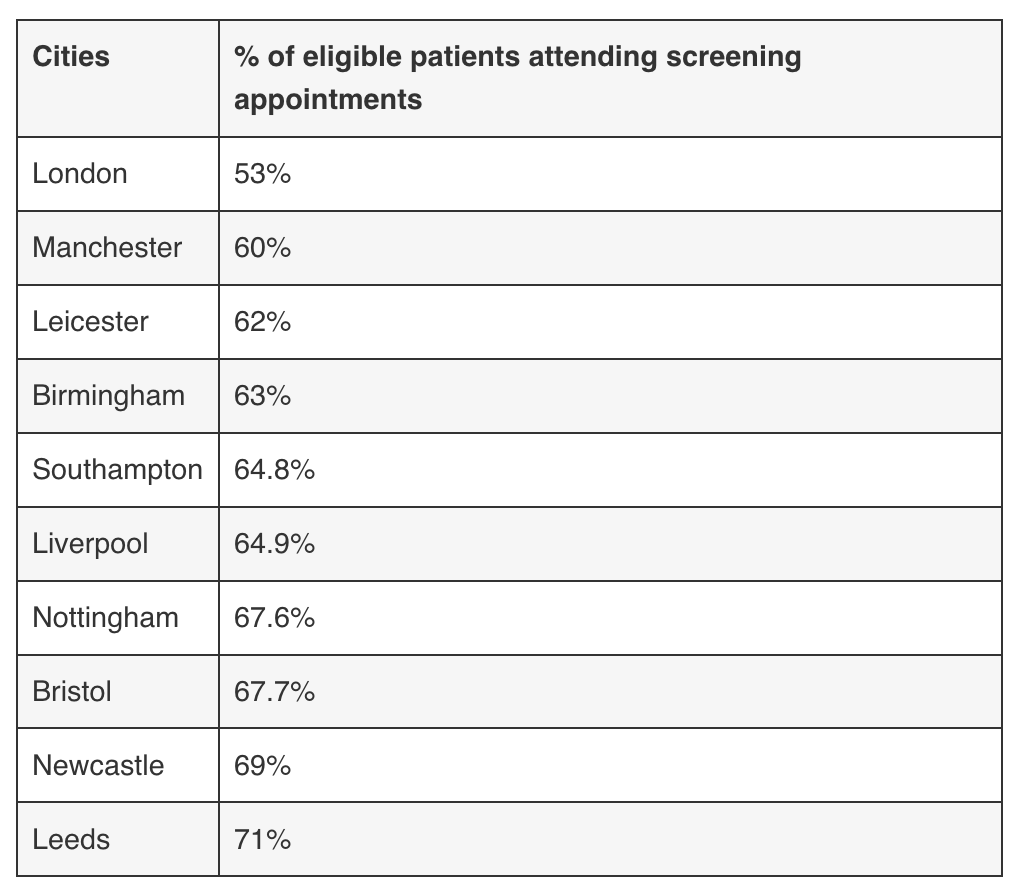
According to Sir Mike Richards’ independent review of adult screening services in England, out of the 15 million adults across England who are invited for a free NHS screening, only approximately 10 million patients attend. If all practices were able to sign-up to the centralised SMS reminder service, there would be an estimated increase in uptake of 5.2 percent – or approximately 780K more patients attending screenings, based on the research.[5]
Considering that in every hundred cancer screenings, at least one abnormality is detected, this means that the increased uptake achieved by the simple SMS reminder could result in approximately 7,800 lives being saved each year.[6]
One of the experts behind the ‘Remind Us’ campaign is Professor Michael Lewis, Head of Life Science Innovation at the University of Birmingham. He comments on why NHS England must act fast:
“There are now several conclusive research papers that reveal the power of sending an SMS reminder to book or attend a screening appointment. This information cannot be ignored. I, for one, have lost too many family members to cancer, to stand-by and not act upon this knowledge.
“Often the most basic technologies can be overlooked, but the research means there’s no reason for NHS England to ignore this call for change. The cost of sending SMS messages to patients is very small, compared to the thousands of pounds required to treat cancer that hasn’t been detected early enough.”
Ivo Vlaev, Professor of Behaviour Science at Warwick Business School is one of the research fellows behind the UK’s first cervical cancer screening SMS study. He supports the interventive campaign:
“I spent a number of years looking into the benefits of interventions such as messages and SMS reminders to increase uptake of screening attendance, and I know that this easy-to-implement method can dramatically improve cancer survival rates in this country. The fact that one text can increase uptake in cervical screening appointments by almost 5 percent, to me is a no brainer, and I whole-heartedly support this campaign to introduce these reminders nationally. I would ask all my friends, colleagues and the public to support this campaign – receiving one letter invitation for cancer screenings isn’t enough.”
SMS reminders in practice
Today, around 85 percent of adult patients have given consent to receive SMS communication from their GP surgery, which confirms the desirability of SMS as a communication medium.[7] The cost of sending two centralised SMS screening reminders to each eligible patient is approximately £2.5m annually, on average, for each type of cancer screening – breast, cervical, and bowel. When comparing the small investment in sending SMS messages to the investment required to treat cervical cancer — which can vary from £1,300 – £19,000 per patient — the economic advantages are clear.
Already, the campaign has the support of cancer charities including breast cancer charity ‘The Pink Ribbon Foundation’ and ‘The Bowel Movement’ charity. Abby Morris, Founder of The Bowel Movement campaign set up the charity after her brother lost his life, aged 32, to bowel cancer – she comments on the importance of the campaign:
“Early detection and diagnosis for bowel cancer has a significant impact on the likelihood of whether an individual will have a successful response to treatment and will survive more than five years following their diagnosis.
“Cancer screenings have dropped by around 80 percent during the pandemic which has had a drastic impact on the ability to detect and diagnose individuals with bowel cancer, with many people not wishing to burden the NHS during this time. This timely campaign is therefore crucial for boosting uptake and attendance at vital screening appointments.”
Get involved, get social
To raise awareness of the importance of attending cancer screenings, and to promote the new campaign, myGP has launched a #RemindUs social media campaign, whereby people can tag the people they are closest to, whilst including the #remindus hashtag to raise awareness of the importance of attending cancer screening appointments.
-ENDS-
For more information, images, case studies or to arrange an interview, please contact Lisa Malyon at Lisa@sensecommunications.co.uk or call 07525204402.
About myGP
- myGP is the UK’s largest independent GP booking and healthcare management app, created by health technology company iPLATO Healthcare, Ltd.
- The myGP app was created to give NHS patients improved, and more convenient access to primary healthcare. By making all services available in one app, users can manage and navigate their own healthcare quickly and efficiently, whilst seeing all the options available to them that they may not have previously been aware of.
- myGP is the health app of choice, used by 1.7 million NHS patients. Its most popular patient features include:
- Booking appointments – Get access to health professionals at the tap of a button, including GPs, practice nurses, or other relevant and available health experts. No need to call and speak to a receptionist – it can all be managed privately, in-app.
- Request repeat prescriptions – Putting an end to writing a letter or completing a form at the practice, patients can request repeat prescription in seconds, in-app.
- Prescription home delivery service – When shielding, immobile, or feeling under the weather, patients can request their prescription be delivered direct to their door at no extra cost. This has been a lifeline for those shielding from Covid-19.
- Access medical records – Users can access their own medical records, including test results. This is especially helpful for those who are caring for others and need to check for information, test results or medication updates on their behalf.
- Recording health data – Users can monitor and record their weight and blood pressure and blood sugar readings.
- Medication reminders – Users can set reminders so they never miss taking their medication, and track when and where medication may have been missed.
[1] Based on 1% of all cancer screenings detecting an abnormality, as outlined in the independent revie5w highlighted below. Out of 15 million cancer screenings for eligible customers, a 5.2% increase in app6ointment uptake would be an additional 780K attendees, of which 1% is 7,800 lives.
[2] myGP data on file.
[3] 5.2% is the average uplift in appointment attendance across the three main cancer screening programmes, when SMS reminders are sent centrally – breast +5.3%, cervical +4.8%, and bowel +5.6%
Breast – https://www.iplato.com/wp-content/uploads/2018/10/Breast-Cancer-Screening-Case-Study.pdf
Bowel – https://www.ncbi.nlm.nih.gov/pmc/articles/PMC5520096/
Cervical https://www.sciencedirect.com/science/article/pii/S0091743520301948
[4] https://www.theguardian.com/society/2020/may/28/cancer-undiagnosed-for-nearly-2000-people-in-uk-every-week
[5] https://www.england.nhs.uk/wp-content/uploads/2019/02/report-of-the-independent-review-of-adult-screening-programme-in-england.pdf /
[6] https://www.england.nhs.uk/wp-content/uploads/2019/02/report-of-the-independent-review-of-adult-screening-programme-in-england.pdf (Of the 10 million attendances each year, 10,000 lives are saved – that’s 1% who are found to have an abnormality.)
[7] myGP data
[i] https://app.powerbi.com/view?r=eyJrIjoiYTFmMjVjYWEtN2MwZS00NWRmLWE0YzAtMmIxNzYxMjdmNWM4IiwidCI6IjUwZjYwNzFmLWJiZmUtNDAxYS04ODAzLTY3Mzc0OGU2MjllMiIsImMiOjh9 (BREAST) https://app.powerbi.com/view?r=eyJrIjoiZDI1YWE4NTQtMjQ0Mi00OGRhLTg1NGMtNTQxYjMwMjVjOTMyIiwidCI6IjUwZjYwNzFmLWJiZmUtNDAxYS04ODAzLTY3Mzc0OGU2MjllMiIsImMiOjh9 (CERVICAL)
© 2026 iPLATO. All rights reserved