
/
Making skin health accessible for all: unveiling the challenges in diagnosing skin conditions on darker skin
Ovarian Cancer: The importance of early detection in the UK
March 15, 2024
The skin is the largest organ of the human body and acts as a protective barrier between the external environment and the inside of the body, shielding the internal organs against heat, light, injury and infection. Yet, the journey to diagnose skin conditions, especially on darker skin tones, can be challenging and not well mapped. In a recent study, physicians were presented with 364 images spanning 46 skin diseases and asked to submit up to four differential diagnoses. The physicians were four percentage points less accurate for the diagnosis of images of dark skin as compared to light skin.
Inherent biases deeply rooted in medical research, literature, and education have led to a healthcare landscape skewed towards lighter skin, often leaving behind those with darker complexions. Doctors diagnose around one-quarter of melanoma cases in Black people when cancer has already spread to nearby lymph nodes. However, amidst these challenges, there are technological advancements, such as AI, that are helping to rectify this imbalance. In May 2024, Autoderm conducted a total of 18,359 analyses through the myGP app and identified 79 cases of melanoma. This equates to about 2-3 melanoma diagnoses per day. Given that approximately 46 melanomas are diagnosed daily across the UK, the cases detected via the myGP app represent about 5% of the total daily melanoma diagnoses in the UK population.
We recognise the need for equitable healthcare solutions for all. Through our partnership with Autoderm, launched in 2023 after years of clinical and AI research, are proud to offer their next generation skin scanner to our community of 3 million users via the myGP app.
The bias in dermatology towards lighter skin tones is a well-documented issue. From medical textbooks to research studies, most visual references and diagnostic criteria are based on observations of mainly fair-skinned individuals.This bias perpetuates a cycle of misdiagnosis and inadequate treatment for patients with darker skin, which can lead to unnecessary distress and prolonged health issues such as increased itching, dryness, skin thickening and hyperpigmentation.
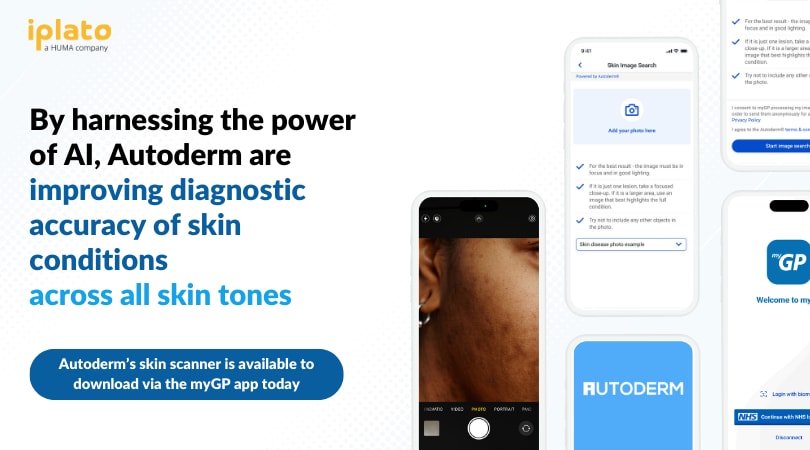
Autoderm and the myGP app, however, are changing the game! By harnessing the power of AI, Autoderm helps improve diagnostic accuracy of skin conditions across all skin tones. Their approach analyses a diverse search engine of skin images (2 million+), encompassing various ethnicities and skin tones. Their algorithm is constantly evolving and learning along with their growing bank of images. Irrespective of skin tone, myGP users can use the tech to get likely answers quickly, easily and choose how to act on the insight.


© 2026 iPLATO. All rights reserved
Practice Area
/
Making skin health accessible for all: unveiling the challenges in diagnosing skin conditions on darker skin
Ovarian Cancer: The importance of early detection in the UK
March 15, 2024
The skin is the largest organ of the human body and acts as a protective barrier between the external environment and the inside of the body, shielding the internal organs against heat, light, injury and infection. Yet, the journey to diagnose skin conditions, especially on darker skin tones, can be challenging and not well mapped. In a recent study, physicians were presented with 364 images spanning 46 skin diseases and asked to submit up to four differential diagnoses. The physicians were four percentage points less accurate for the diagnosis of images of dark skin as compared to light skin.
Inherent biases deeply rooted in medical research, literature, and education have led to a healthcare landscape skewed towards lighter skin, often leaving behind those with darker complexions. Doctors diagnose around one-quarter of melanoma cases in Black people when cancer has already spread to nearby lymph nodes. However, amidst these challenges, there are technological advancements, such as AI, that are helping to rectify this imbalance. In May 2024, Autoderm conducted a total of 18,359 analyses through the myGP app and identified 79 cases of melanoma. This equates to about 2-3 melanoma diagnoses per day. Given that approximately 46 melanomas are diagnosed daily across the UK, the cases detected via the myGP app represent about 5% of the total daily melanoma diagnoses in the UK population.
We recognise the need for equitable healthcare solutions for all. Through our partnership with Autoderm, launched in 2023 after years of clinical and AI research, are proud to offer their next generation skin scanner to our community of 3 million users via the myGP app.
The bias in dermatology towards lighter skin tones is a well-documented issue. From medical textbooks to research studies, most visual references and diagnostic criteria are based on observations of mainly fair-skinned individuals.This bias perpetuates a cycle of misdiagnosis and inadequate treatment for patients with darker skin, which can lead to unnecessary distress and prolonged health issues such as increased itching, dryness, skin thickening and hyperpigmentation.
Autoderm and the myGP app, however, are changing the game! By harnessing the power of AI, Autoderm helps improve diagnostic accuracy of skin conditions across all skin tones. Their approach analyses a diverse search engine of skin images (2 million+), encompassing various ethnicities and skin tones. Their algorithm is constantly evolving and learning along with their growing bank of images. Irrespective of skin tone, myGP users can use the tech to get likely answers quickly, easily and choose how to act on the insight.
© 2026 iPLATO. All rights reserved
Ovarian Cancer: The importance of early detection in the UK
March 15, 2024

March 2024 marks Ovarian Cancer Awareness Month in the UK, a crucial time to shed light on this potentially fatal disease. As a doctor and as a women ovarian cancer is a worry. Due to the non-specific symptoms, it is hard to recognise. It is important that women who notice abdominal symptoms know they can raise their concerns with their doctor, and that they will be listened to and have the necessary investigations. Raising awareness of the disease and the signs and symptoms is important so that more women are diagnosed earlier when the disease is easier to treat.
Ovarian Cancer in the UK:
According to recent statistics, ovarian cancer is the sixth most common cancer among women in the UK. Each year, around 7,500 women are diagnosed with this disease, with over 4,100 losing their lives to it. Despite these alarming figures, ovarian cancer remains a silent killer due to its vague symptoms and late-stage detection.
Recognising the Symptoms:
Ovarian cancer symptoms can be subtle and easily overlooked, contributing to its late diagnosis. Common warning signs include:
- a swollen tummy or feeling bloated
- pain or tenderness in your tummy or the area between the hips (pelvis)
- no appetite or feeling full quickly after eating
- an urgent need to pee or needing to pee more often
Fatigue, changes in bowel habits, and unexplained weight loss can also be indicators. However, these symptoms are often mistaken for less severe issues, leading to delayed medical attention.
Early Detection:
The key to combating ovarian cancer lies in early detection. 93% of people diagnosed with ovarian cancer survive their disease for 5 years or more if diagnosed at the earliest stage (stage 1) compared to just 13% when diagnosed at the latest stage (stage 4). Unfortunately, due to its elusive nature, ovarian cancer is often identified at an advanced stage, making successful treatment more challenging.
iPLATO’s Commitment to Ovarian Cancer Awareness
At iPLATO, we understand the power of knowledge and early intervention. Our commitment extends beyond technological solutions to supporting initiatives that raise awareness and promote early detection. Ovarian Cancer Awareness Month serves as a vital reminder that understanding symptoms, seeking timely medical attention, and advocating for increased awareness are crucial steps in the battle against ovarian cancer.
Katerina, Project Manager for iPLATO’s cancer screening programmes, which include bowel, cervical, breast, prostate, oesophageal – commented, “Ovarian Cancer Awareness Month highlights the importance of early detection, a mission central to our work at iPLATO. By leveraging technology to increase the number of people attending their screening appointments, we aim to empower people to recognise symptoms and seek early intervention. Together, we can improve outcomes and save lives”
© 2026 iPLATO. All rights reserved