
/
Making skin health accessible for all: unveiling the challenges in diagnosing skin conditions on darker skin
myGP update in response to Covid-19
March 19, 2020
The skin is the largest organ of the human body and acts as a protective barrier between the external environment and the inside of the body, shielding the internal organs against heat, light, injury and infection. Yet, the journey to diagnose skin conditions, especially on darker skin tones, can be challenging and not well mapped. In a recent study, physicians were presented with 364 images spanning 46 skin diseases and asked to submit up to four differential diagnoses. The physicians were four percentage points less accurate for the diagnosis of images of dark skin as compared to light skin.
Inherent biases deeply rooted in medical research, literature, and education have led to a healthcare landscape skewed towards lighter skin, often leaving behind those with darker complexions. Doctors diagnose around one-quarter of melanoma cases in Black people when cancer has already spread to nearby lymph nodes. However, amidst these challenges, there are technological advancements, such as AI, that are helping to rectify this imbalance. In May 2024, Autoderm conducted a total of 18,359 analyses through the myGP app and identified 79 cases of melanoma. This equates to about 2-3 melanoma diagnoses per day. Given that approximately 46 melanomas are diagnosed daily across the UK, the cases detected via the myGP app represent about 5% of the total daily melanoma diagnoses in the UK population.
We recognise the need for equitable healthcare solutions for all. Through our partnership with Autoderm, launched in 2023 after years of clinical and AI research, are proud to offer their next generation skin scanner to our community of 3 million users via the myGP app.
The bias in dermatology towards lighter skin tones is a well-documented issue. From medical textbooks to research studies, most visual references and diagnostic criteria are based on observations of mainly fair-skinned individuals.This bias perpetuates a cycle of misdiagnosis and inadequate treatment for patients with darker skin, which can lead to unnecessary distress and prolonged health issues such as increased itching, dryness, skin thickening and hyperpigmentation.
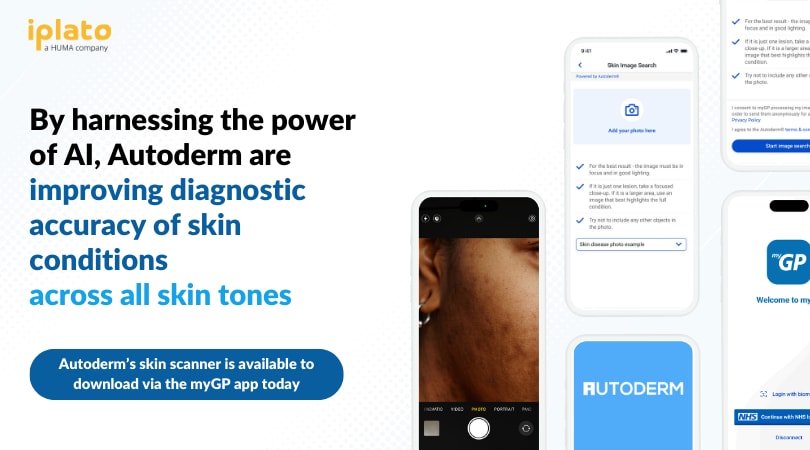
Autoderm and the myGP app, however, are changing the game! By harnessing the power of AI, Autoderm helps improve diagnostic accuracy of skin conditions across all skin tones. Their approach analyses a diverse search engine of skin images (2 million+), encompassing various ethnicities and skin tones. Their algorithm is constantly evolving and learning along with their growing bank of images. Irrespective of skin tone, myGP users can use the tech to get likely answers quickly, easily and choose how to act on the insight.


© 2026 iPLATO. All rights reserved
Practice Area
/
Making skin health accessible for all: unveiling the challenges in diagnosing skin conditions on darker skin
myGP update in response to Covid-19
March 19, 2020
The skin is the largest organ of the human body and acts as a protective barrier between the external environment and the inside of the body, shielding the internal organs against heat, light, injury and infection. Yet, the journey to diagnose skin conditions, especially on darker skin tones, can be challenging and not well mapped. In a recent study, physicians were presented with 364 images spanning 46 skin diseases and asked to submit up to four differential diagnoses. The physicians were four percentage points less accurate for the diagnosis of images of dark skin as compared to light skin.
Inherent biases deeply rooted in medical research, literature, and education have led to a healthcare landscape skewed towards lighter skin, often leaving behind those with darker complexions. Doctors diagnose around one-quarter of melanoma cases in Black people when cancer has already spread to nearby lymph nodes. However, amidst these challenges, there are technological advancements, such as AI, that are helping to rectify this imbalance. In May 2024, Autoderm conducted a total of 18,359 analyses through the myGP app and identified 79 cases of melanoma. This equates to about 2-3 melanoma diagnoses per day. Given that approximately 46 melanomas are diagnosed daily across the UK, the cases detected via the myGP app represent about 5% of the total daily melanoma diagnoses in the UK population.
We recognise the need for equitable healthcare solutions for all. Through our partnership with Autoderm, launched in 2023 after years of clinical and AI research, are proud to offer their next generation skin scanner to our community of 3 million users via the myGP app.
The bias in dermatology towards lighter skin tones is a well-documented issue. From medical textbooks to research studies, most visual references and diagnostic criteria are based on observations of mainly fair-skinned individuals.This bias perpetuates a cycle of misdiagnosis and inadequate treatment for patients with darker skin, which can lead to unnecessary distress and prolonged health issues such as increased itching, dryness, skin thickening and hyperpigmentation.
Autoderm and the myGP app, however, are changing the game! By harnessing the power of AI, Autoderm helps improve diagnostic accuracy of skin conditions across all skin tones. Their approach analyses a diverse search engine of skin images (2 million+), encompassing various ethnicities and skin tones. Their algorithm is constantly evolving and learning along with their growing bank of images. Irrespective of skin tone, myGP users can use the tech to get likely answers quickly, easily and choose how to act on the insight.
© 2026 iPLATO. All rights reserved
myGP update in response to Covid-19
March 19, 2020

iPLATO, the developers of myGP®, have made several upgrades to its Remote Consultation module in a bid to help users meet the needs of patients during the current Covid-19 outbreak. Improvements include adding Remote Consultation ‘Enterprise’ capability which allows teams of clinicians to collaborate across multiple GP practices in providing digital care to patients.
Released late last week, the upgrade enables practices to use Remote Consultation to filter and review all appointments, whether booked via the myGP app, by phone, patient walk-in or using another online system. The clinician can review the booked appointments with the aim to triage and assess the patient ahead of time. This means clinicians can ensure that medicine reviews, asthma reviews and other routine appointments are conducted remotely, reducing footfall to the surgery as well as reviewing consultations due to take place with vulnerable or at-risk patients.
From within Remote Consultation on the myGP platform, clinicians can send messages to patients, either to gather further information, such as travel history, or to inform them that their appointment will be conducted remotely, with video consultations being initiated from within the same platform. Further changes to the module also involve including several filters, so that appointments can be viewed by appointment type, booking type, booking method or a free-text search function for keywords such as ‘cough’ or ‘fever’.
In addition to the upgrades to Remote Consultation for GP practices, iPLATO are launching a first version of Remote Consultation ‘Enterprise’ this week. Enterprise will enable an approved clinician to use the platform to triage and initiate a video of message consultation with someone at any practice, a solution designed for PCNs and CCGs to optimise digital health services across their population.
Talking of the developments CEO Tobias Alpsten commented:
‘Using the myGP platform to manage everything from outbound patient engagement, appointment booking through to triage and video consultation primary care can continue to play its key role in managing the Covid-19 pandemic. As our solution is web-based it means that a clinician can use the platform from his or her own device while working from home, triaging appointments and conducting them remotely while possibly being in isolation. Our customers have highlighted the speed and difference that this functionality has made when selecting the most appropriate appointment type for each patient and we are continuing to work with our customers and patients to best understand what further developments we can continue to make to ensure the myGP platform best fits the needs of primary care during this time.’
myGP, accessed via a smartphone app by patients and through a secure web interface by clinicians, is the UK’s largest independent medical app with 1.6 million active users. Currently used in over 6,500 GP practices, myGP was the most downloaded medical app in the UK in 2019.
ENDS
© 2026 iPLATO. All rights reserved