
/
Making skin health accessible for all: unveiling the challenges in diagnosing skin conditions on darker skin
Kent County Council increases uptake of symptom-free COVID-19 testing by 32% using SMS invitations
March 25, 2021
The skin is the largest organ of the human body and acts as a protective barrier between the external environment and the inside of the body, shielding the internal organs against heat, light, injury and infection. Yet, the journey to diagnose skin conditions, especially on darker skin tones, can be challenging and not well mapped. In a recent study, physicians were presented with 364 images spanning 46 skin diseases and asked to submit up to four differential diagnoses. The physicians were four percentage points less accurate for the diagnosis of images of dark skin as compared to light skin.
Inherent biases deeply rooted in medical research, literature, and education have led to a healthcare landscape skewed towards lighter skin, often leaving behind those with darker complexions. Doctors diagnose around one-quarter of melanoma cases in Black people when cancer has already spread to nearby lymph nodes. However, amidst these challenges, there are technological advancements, such as AI, that are helping to rectify this imbalance. In May 2024, Autoderm conducted a total of 18,359 analyses through the myGP app and identified 79 cases of melanoma. This equates to about 2-3 melanoma diagnoses per day. Given that approximately 46 melanomas are diagnosed daily across the UK, the cases detected via the myGP app represent about 5% of the total daily melanoma diagnoses in the UK population.
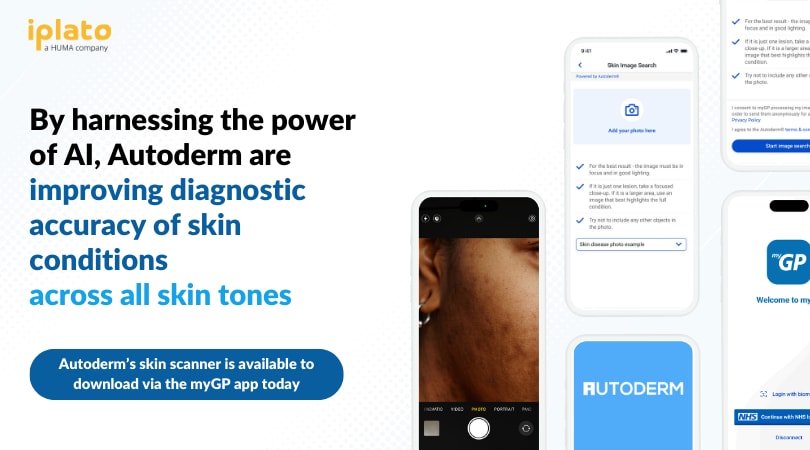
We recognise the need for equitable healthcare solutions for all. Through our partnership with Autoderm, launched in 2023 after years of clinical and AI research, are proud to offer their next generation skin scanner to our community of 3 million users via the myGP app.
The bias in dermatology towards lighter skin tones is a well-documented issue. From medical textbooks to research studies, most visual references and diagnostic criteria are based on observations of mainly fair-skinned individuals.This bias perpetuates a cycle of misdiagnosis and inadequate treatment for patients with darker skin, which can lead to unnecessary distress and prolonged health issues such as increased itching, dryness, skin thickening and hyperpigmentation.
Autoderm and the myGP app, however, are changing the game! By harnessing the power of AI, Autoderm helps improve diagnostic accuracy of skin conditions across all skin tones. Their approach analyses a diverse search engine of skin images (2 million+), encompassing various ethnicities and skin tones. Their algorithm is constantly evolving and learning along with their growing bank of images. Irrespective of skin tone, myGP users can use the tech to get likely answers quickly, easily and choose how to act on the insight.


© 2026 iPLATO. All rights reserved
Practice Area
/
Making skin health accessible for all: unveiling the challenges in diagnosing skin conditions on darker skin
Kent County Council increases uptake of symptom-free COVID-19 testing by 32% using SMS invitations
March 25, 2021
The skin is the largest organ of the human body and acts as a protective barrier between the external environment and the inside of the body, shielding the internal organs against heat, light, injury and infection. Yet, the journey to diagnose skin conditions, especially on darker skin tones, can be challenging and not well mapped. In a recent study, physicians were presented with 364 images spanning 46 skin diseases and asked to submit up to four differential diagnoses. The physicians were four percentage points less accurate for the diagnosis of images of dark skin as compared to light skin.
Inherent biases deeply rooted in medical research, literature, and education have led to a healthcare landscape skewed towards lighter skin, often leaving behind those with darker complexions. Doctors diagnose around one-quarter of melanoma cases in Black people when cancer has already spread to nearby lymph nodes. However, amidst these challenges, there are technological advancements, such as AI, that are helping to rectify this imbalance. In May 2024, Autoderm conducted a total of 18,359 analyses through the myGP app and identified 79 cases of melanoma. This equates to about 2-3 melanoma diagnoses per day. Given that approximately 46 melanomas are diagnosed daily across the UK, the cases detected via the myGP app represent about 5% of the total daily melanoma diagnoses in the UK population.
We recognise the need for equitable healthcare solutions for all. Through our partnership with Autoderm, launched in 2023 after years of clinical and AI research, are proud to offer their next generation skin scanner to our community of 3 million users via the myGP app.
The bias in dermatology towards lighter skin tones is a well-documented issue. From medical textbooks to research studies, most visual references and diagnostic criteria are based on observations of mainly fair-skinned individuals.This bias perpetuates a cycle of misdiagnosis and inadequate treatment for patients with darker skin, which can lead to unnecessary distress and prolonged health issues such as increased itching, dryness, skin thickening and hyperpigmentation.
Autoderm and the myGP app, however, are changing the game! By harnessing the power of AI, Autoderm helps improve diagnostic accuracy of skin conditions across all skin tones. Their approach analyses a diverse search engine of skin images (2 million+), encompassing various ethnicities and skin tones. Their algorithm is constantly evolving and learning along with their growing bank of images. Irrespective of skin tone, myGP users can use the tech to get likely answers quickly, easily and choose how to act on the insight.
© 2026 iPLATO. All rights reserved
/
Kent County Council increases uptake of symptom-free COVID-19 testing by 32% using SMS invitations
Kent County Council increases uptake of symptom-free COVID-19 testing by 32% using SMS invitations
March 25, 2021
- Kent saw a dramatic increase in COVID-19 cases while testing uptake declined at the turn of the year
- Using the myGP Engagement Hub’s SMS communications the Council increased symptom free testing by 32% across the county, the equivalent of over 1000 additional tests a day
Through the last three months of 2020 cases of COVID-19 in Kent were dramatically increasing after the discovery of a new, more transmissible variant of COVID-19. In response to this, Kent County Council created and implemented 24 symptom-free testing sites across the county which started to be operational between the middle of December and January this year. To increase awareness of the testing sites and to encourage uptake in order to contain transmission of the virus, the County required a solution that was simple, fast and effective.
In addition, the media’s focus on the ‘Kent strain’ of the virus, required public health officials to inform residents quickly and securely about the 24 testing sites available across the county; thereby help to contain the spread and demonstrating their commitment to ensuring public safety.
Andrew Scott-Clark Director of Public Health at Kent County Council commented “We were looking for a solution to encourage uptake fast, so we spoke to our colleagues in primary care who informed us of myGP’s Engagement Hub solution which is used across the country to increase uptake to cancer screenings, vaccination and health checks. It seemed the perfect option.”
myGP’s Engagement Hub allows for personalised and location specific SMS messages to target demographics with no input from GP surgeries themselves.
Andrew continued “utilising the myGP Engagement Hub, we got immediate results including increasing uptake of tests, reducing waste, and helping to support the reduction in case numbers across the county.”
Following the campaign Kent Council saw an increase of over 1,000 people a day opt-in to attend and receive an asymptomatic COVID-19 test throughout the county, an increase in 32%, averaging 1025 a day additional tests being completed.
Luke Wyatt, business unit manager at myGP said ‘our engagement hub has been used across the country during the pandemic. In times like this, simple, direct communication is what is needed – letting people know what is available and how to action it and ensuring there is one consistent message. We hear stories of testing centres having a number of wasted appointments, or people not knowing about them and we are really proud to have helped Kent to increase uptake via SMS communication and in turn manage its case load and stop the spread of the virus in the region. We use the same Hub to promote vaccination including our own mobile vaccination card called myGP TICKet’.
myGP Engagement Hub can extract data from patient records across a CCG, STP or entire region to centralise patient communication, including phone number, address or email. The platform can target specific criteria of patients via multiple communication methods at scale, without the need for practice to be involvement and all communications can be delivered to patients from the one central myGP system.
myGP continues to support the fight against COVID-19, having developed the first vaccination verification feature to launch in England. The myGP TICKet, which begins beta testing in mid-March, will allow businesses whose viability depends upon operating at capacity – such as the retail, leisure, the arts and hospitality sectors – the ability to open either full or part-time to vaccinated individuals, without the need to observe strict social distancing rules. In addition, the technology will reduce the administrative burden on GPs, who will likely be busy with requests for verification of vaccination status as people begin to return to everyday life around the country.
© 2026 iPLATO. All rights reserved