

/
Making skin health accessible for all: unveiling the challenges in diagnosing skin conditions on darker skin
Is Video Consultation the way forward for General Practice?
January 11, 2017
The skin is the largest organ of the human body and acts as a protective barrier between the external environment and the inside of the body, shielding the internal organs against heat, light, injury and infection. Yet, the journey to diagnose skin conditions, especially on darker skin tones, can be challenging and not well mapped. In a recent study, physicians were presented with 364 images spanning 46 skin diseases and asked to submit up to four differential diagnoses. The physicians were four percentage points less accurate for the diagnosis of images of dark skin as compared to light skin.
Inherent biases deeply rooted in medical research, literature, and education have led to a healthcare landscape skewed towards lighter skin, often leaving behind those with darker complexions. Doctors diagnose around one-quarter of melanoma cases in Black people when cancer has already spread to nearby lymph nodes. However, amidst these challenges, there are technological advancements, such as AI, that are helping to rectify this imbalance. In May 2024, Autoderm conducted a total of 18,359 analyses through the myGP app and identified 79 cases of melanoma. This equates to about 2-3 melanoma diagnoses per day. Given that approximately 46 melanomas are diagnosed daily across the UK, the cases detected via the myGP app represent about 5% of the total daily melanoma diagnoses in the UK population.
We recognise the need for equitable healthcare solutions for all. Through our partnership with Autoderm, launched in 2023 after years of clinical and AI research, are proud to offer their next generation skin scanner to our community of 3 million users via the myGP app.
The bias in dermatology towards lighter skin tones is a well-documented issue. From medical textbooks to research studies, most visual references and diagnostic criteria are based on observations of mainly fair-skinned individuals.This bias perpetuates a cycle of misdiagnosis and inadequate treatment for patients with darker skin, which can lead to unnecessary distress and prolonged health issues such as increased itching, dryness, skin thickening and hyperpigmentation.
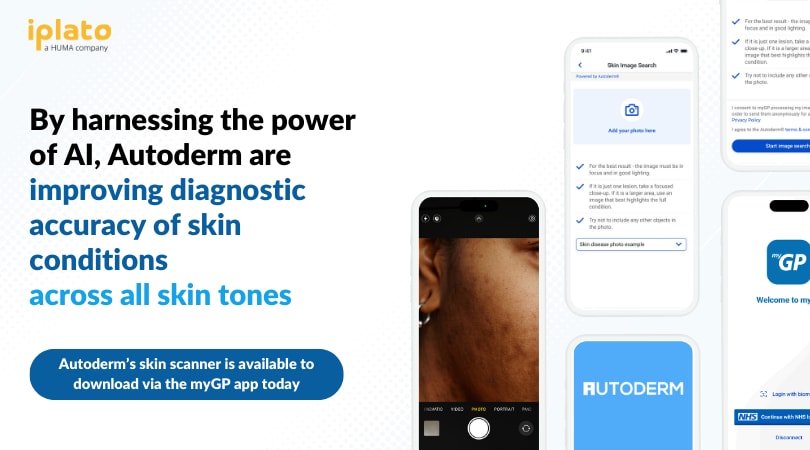
Autoderm and the myGP app, however, are changing the game! By harnessing the power of AI, Autoderm helps improve diagnostic accuracy of skin conditions across all skin tones. Their approach analyses a diverse search engine of skin images (2 million+), encompassing various ethnicities and skin tones. Their algorithm is constantly evolving and learning along with their growing bank of images. Irrespective of skin tone, myGP users can use the tech to get likely answers quickly, easily and choose how to act on the insight.


© 2026 iPLATO. All rights reserved
Practice Area
/
Making skin health accessible for all: unveiling the challenges in diagnosing skin conditions on darker skin
Is Video Consultation the way forward for General Practice?
January 11, 2017
The skin is the largest organ of the human body and acts as a protective barrier between the external environment and the inside of the body, shielding the internal organs against heat, light, injury and infection. Yet, the journey to diagnose skin conditions, especially on darker skin tones, can be challenging and not well mapped. In a recent study, physicians were presented with 364 images spanning 46 skin diseases and asked to submit up to four differential diagnoses. The physicians were four percentage points less accurate for the diagnosis of images of dark skin as compared to light skin.
Inherent biases deeply rooted in medical research, literature, and education have led to a healthcare landscape skewed towards lighter skin, often leaving behind those with darker complexions. Doctors diagnose around one-quarter of melanoma cases in Black people when cancer has already spread to nearby lymph nodes. However, amidst these challenges, there are technological advancements, such as AI, that are helping to rectify this imbalance. In May 2024, Autoderm conducted a total of 18,359 analyses through the myGP app and identified 79 cases of melanoma. This equates to about 2-3 melanoma diagnoses per day. Given that approximately 46 melanomas are diagnosed daily across the UK, the cases detected via the myGP app represent about 5% of the total daily melanoma diagnoses in the UK population.
We recognise the need for equitable healthcare solutions for all. Through our partnership with Autoderm, launched in 2023 after years of clinical and AI research, are proud to offer their next generation skin scanner to our community of 3 million users via the myGP app.
The bias in dermatology towards lighter skin tones is a well-documented issue. From medical textbooks to research studies, most visual references and diagnostic criteria are based on observations of mainly fair-skinned individuals.This bias perpetuates a cycle of misdiagnosis and inadequate treatment for patients with darker skin, which can lead to unnecessary distress and prolonged health issues such as increased itching, dryness, skin thickening and hyperpigmentation.
Autoderm and the myGP app, however, are changing the game! By harnessing the power of AI, Autoderm helps improve diagnostic accuracy of skin conditions across all skin tones. Their approach analyses a diverse search engine of skin images (2 million+), encompassing various ethnicities and skin tones. Their algorithm is constantly evolving and learning along with their growing bank of images. Irrespective of skin tone, myGP users can use the tech to get likely answers quickly, easily and choose how to act on the insight.
© 2026 iPLATO. All rights reserved
Is Video Consultation the way forward for General Practice?
January 11, 2017
I was sat with one of the most tech savvy and IT literate GPs in London, Dr Numa Thebe, enjoying coffee before our presentation to the NHS SBRI panel, and we were looking at the challenges faced by busy GPs especially in London. Every time I talk with GPs, I am always inspired by their dedication and commitment despite all the pressures they face and want to hear how they can improve the service they provide.
We started to talk about video consultation and whether this was a good or bad thing – I confess I was slightly pre-warmed up having talked with nearly 14 CCGs in the past month on exactly the same subject. Video does sound enticing as you could be sitting in a home office or in the practice and instead of facing the stream of sniffles and coughs from patients coming into the surgery, you could be sat behind a video screen with all the patient data in front of you. After all no-one ever got flu from a video camera.
So why isn’t this technology taking off, after all isn’t it convenient for the patient and clinician?
In reality, video consultations have been monopolised by the providers of private GP appointments. This is where a doctor you have never met, who can’t access your medical history, who has no way of taking any measurements eg BP, and can’t add any notes digitally to your continuing record of care, listens to you for about £2 a minute, and the faxes or emails a prescription to a pharmacy somewhere within a 50 mile radius of your house.
Outside of the private providers, this has been tried in Scotland where patients are geographically distant from their GP, but even then the technology wasn’t sustainable. In fact, when we can’t make simple mobile phone calls work on a Virgin train from Euston to Birmingham (last week) how can we hope to hold millions of video consultations across inter and intra-operable networks. Point-to-point video, like the private providers provide is as easy as me “Face-timing” or “Whatsapping” my mother, but general practice is not that simple and security is a concern.
The other issue is that 95% of GPs I have spoken with (n ~ 150) don’t like, want or need video as desperately as non-clinicians think they need it.
- Reason 1:
GPs multi-task, and a video call means they need to be front and centre for all the video call. They can’t be looking through papers, reading reports or having a cup of tea at the same time. - Reason 2:
GPs look for cues apart from video, and rely on more than one sense e.g. How did the patient look as they walked to the chair in front of the clinician, did their foot drop? - Reason 3:
Being a GP is a vocation not a call centre, most (OK not all) GPs like human contact, this is one of the benefits of the job, helping people.
So will video take off and all the money allocated to it be used? In my opinion the answer is No. Any money allocated to this will be underspent and not available for doing really important health initiatives with measurable health outcomes such as improving attendance at cancer screening clinics, expanding the immunisation bracket for shingles or promoting Measles vaccination for children.
Video is for gaming and entertainment, on which note back to the box set of Walking Dead
© 2026 iPLATO. All rights reserved