
/
Making skin health accessible for all: unveiling the challenges in diagnosing skin conditions on darker skin
Introducing Intelligent Care Navigation
June 26, 2017
The skin is the largest organ of the human body and acts as a protective barrier between the external environment and the inside of the body, shielding the internal organs against heat, light, injury and infection. Yet, the journey to diagnose skin conditions, especially on darker skin tones, can be challenging and not well mapped. In a recent study, physicians were presented with 364 images spanning 46 skin diseases and asked to submit up to four differential diagnoses. The physicians were four percentage points less accurate for the diagnosis of images of dark skin as compared to light skin.
Inherent biases deeply rooted in medical research, literature, and education have led to a healthcare landscape skewed towards lighter skin, often leaving behind those with darker complexions. Doctors diagnose around one-quarter of melanoma cases in Black people when cancer has already spread to nearby lymph nodes. However, amidst these challenges, there are technological advancements, such as AI, that are helping to rectify this imbalance. In May 2024, Autoderm conducted a total of 18,359 analyses through the myGP app and identified 79 cases of melanoma. This equates to about 2-3 melanoma diagnoses per day. Given that approximately 46 melanomas are diagnosed daily across the UK, the cases detected via the myGP app represent about 5% of the total daily melanoma diagnoses in the UK population.
We recognise the need for equitable healthcare solutions for all. Through our partnership with Autoderm, launched in 2023 after years of clinical and AI research, are proud to offer their next generation skin scanner to our community of 3 million users via the myGP app.
The bias in dermatology towards lighter skin tones is a well-documented issue. From medical textbooks to research studies, most visual references and diagnostic criteria are based on observations of mainly fair-skinned individuals.This bias perpetuates a cycle of misdiagnosis and inadequate treatment for patients with darker skin, which can lead to unnecessary distress and prolonged health issues such as increased itching, dryness, skin thickening and hyperpigmentation.
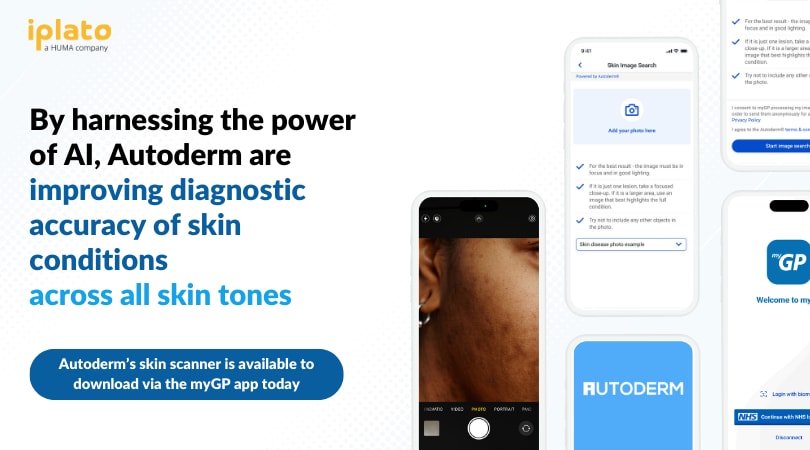
Autoderm and the myGP app, however, are changing the game! By harnessing the power of AI, Autoderm helps improve diagnostic accuracy of skin conditions across all skin tones. Their approach analyses a diverse search engine of skin images (2 million+), encompassing various ethnicities and skin tones. Their algorithm is constantly evolving and learning along with their growing bank of images. Irrespective of skin tone, myGP users can use the tech to get likely answers quickly, easily and choose how to act on the insight.


© 2026 iPLATO. All rights reserved
Practice Area
/
Making skin health accessible for all: unveiling the challenges in diagnosing skin conditions on darker skin
Introducing Intelligent Care Navigation
June 26, 2017
The skin is the largest organ of the human body and acts as a protective barrier between the external environment and the inside of the body, shielding the internal organs against heat, light, injury and infection. Yet, the journey to diagnose skin conditions, especially on darker skin tones, can be challenging and not well mapped. In a recent study, physicians were presented with 364 images spanning 46 skin diseases and asked to submit up to four differential diagnoses. The physicians were four percentage points less accurate for the diagnosis of images of dark skin as compared to light skin.
Inherent biases deeply rooted in medical research, literature, and education have led to a healthcare landscape skewed towards lighter skin, often leaving behind those with darker complexions. Doctors diagnose around one-quarter of melanoma cases in Black people when cancer has already spread to nearby lymph nodes. However, amidst these challenges, there are technological advancements, such as AI, that are helping to rectify this imbalance. In May 2024, Autoderm conducted a total of 18,359 analyses through the myGP app and identified 79 cases of melanoma. This equates to about 2-3 melanoma diagnoses per day. Given that approximately 46 melanomas are diagnosed daily across the UK, the cases detected via the myGP app represent about 5% of the total daily melanoma diagnoses in the UK population.
We recognise the need for equitable healthcare solutions for all. Through our partnership with Autoderm, launched in 2023 after years of clinical and AI research, are proud to offer their next generation skin scanner to our community of 3 million users via the myGP app.
The bias in dermatology towards lighter skin tones is a well-documented issue. From medical textbooks to research studies, most visual references and diagnostic criteria are based on observations of mainly fair-skinned individuals.This bias perpetuates a cycle of misdiagnosis and inadequate treatment for patients with darker skin, which can lead to unnecessary distress and prolonged health issues such as increased itching, dryness, skin thickening and hyperpigmentation.
Autoderm and the myGP app, however, are changing the game! By harnessing the power of AI, Autoderm helps improve diagnostic accuracy of skin conditions across all skin tones. Their approach analyses a diverse search engine of skin images (2 million+), encompassing various ethnicities and skin tones. Their algorithm is constantly evolving and learning along with their growing bank of images. Irrespective of skin tone, myGP users can use the tech to get likely answers quickly, easily and choose how to act on the insight.
© 2026 iPLATO. All rights reserved
Introducing Intelligent Care Navigation
June 26, 2017
iPLATO Healthcare has been awarded a contract by The Small Business Research Initiative for Healthcare (SBRI Healthcare) to develop and trial ‘Intelligent Care Navigation’, to improve access to care for patients and help the NHS manage demand for primary care services. The trial will include a small number of practices and take place from June to August.
In partnership with GP practices, this new approach will provide patients with personalised, localised and quality assured information to help some of them receive appropriate care faster than waiting for their scheduled GP appointment.
Research suggests that only 1 in 3 people visiting a GP practice should be seen by a doctor and half of patients currently being seen by GPs could be seen by another member of the clinical team1. Today, around 7,700 GP practices are managing a staggering 372 million appointments according to NHS England figures. Switching some of these GP appointments to appropriate interventions by other healthcare professionals can save the NHS millions.
Available exclusively to patients who book their appointment on myGP®, the trial service will capture patient reasons for booking an appointment and, where relevant and safe, signpost them to suitable alternatives to traditional face-to-face consultations with a GP. Safety is paramount to the service. Therefore, it will only be available to patients of participating GP practices who will approve any alternatives presented to the patient. Alternative services could include: local pharmacies, alternate clinicians within the practice, locally commissioned services, digital health solutions and support services.
SBRI awarded the investment to digital health specialist iPLATO based on their successful launch of the revolutionary new smartphone app, myGP last year. The iPLATO platform now has 15 million NHS patients connected spanning over 1,650 GP practices across the UK, helping to speed up access to care and uptake of national screening programmes for patients, loved ones and their carers.
This intuitive approach to intelligent care navigation will not only reduce the need and pressure on GP appointments but will also help patients gain better access to instant medical care and advice, while helping GPs to run their practices more efficiently. The beauty of this service is that it helps patients to stay within this NHS environment whilst receiving the care they need, strengthens the patient/GP relationship and enables users to access unparalleled care 24/7.
Initially, the plan is to run a 6-month development and trial programme using this smarter approach with a view to extending the service to other practices during Phase 2 of the programme.
Tobias Alpsten, CEO, iPLATO comments;
“We are all incredibly excited about the investment from SBRI, allowing us to introduce a smarter and seamless process to care navigation. Transforming access to primary care offers obvious advantages to patients and their carers, but it also benefits commissioners and tax payers by reducing pressure on the healthcare system. We believe an intuitive and robust approach to empowering the patient through quality information and alternative pathways can make a real difference in improving access to healthcare, ensuring patients are seen promptly by the most appropriate healthcare professional as well as supporting those living with long-term health conditions.”
- NHS England National Audit Office, 2015 https://www.nao.org.uk/wp-content/uploads/2015/11/Stocktake-of-access-to-general-practice-in-England-Summary.pdf
© 2026 iPLATO. All rights reserved