
/
Making skin health accessible for all: unveiling the challenges in diagnosing skin conditions on darker skin
Expanding Choice. Simplifying Access. Improving Health.
December 7, 2020
The skin is the largest organ of the human body and acts as a protective barrier between the external environment and the inside of the body, shielding the internal organs against heat, light, injury and infection. Yet, the journey to diagnose skin conditions, especially on darker skin tones, can be challenging and not well mapped. In a recent study, physicians were presented with 364 images spanning 46 skin diseases and asked to submit up to four differential diagnoses. The physicians were four percentage points less accurate for the diagnosis of images of dark skin as compared to light skin.
Inherent biases deeply rooted in medical research, literature, and education have led to a healthcare landscape skewed towards lighter skin, often leaving behind those with darker complexions. Doctors diagnose around one-quarter of melanoma cases in Black people when cancer has already spread to nearby lymph nodes. However, amidst these challenges, there are technological advancements, such as AI, that are helping to rectify this imbalance. In May 2024, Autoderm conducted a total of 18,359 analyses through the myGP app and identified 79 cases of melanoma. This equates to about 2-3 melanoma diagnoses per day. Given that approximately 46 melanomas are diagnosed daily across the UK, the cases detected via the myGP app represent about 5% of the total daily melanoma diagnoses in the UK population.
We recognise the need for equitable healthcare solutions for all. Through our partnership with Autoderm, launched in 2023 after years of clinical and AI research, are proud to offer their next generation skin scanner to our community of 3 million users via the myGP app.
The bias in dermatology towards lighter skin tones is a well-documented issue. From medical textbooks to research studies, most visual references and diagnostic criteria are based on observations of mainly fair-skinned individuals.This bias perpetuates a cycle of misdiagnosis and inadequate treatment for patients with darker skin, which can lead to unnecessary distress and prolonged health issues such as increased itching, dryness, skin thickening and hyperpigmentation.
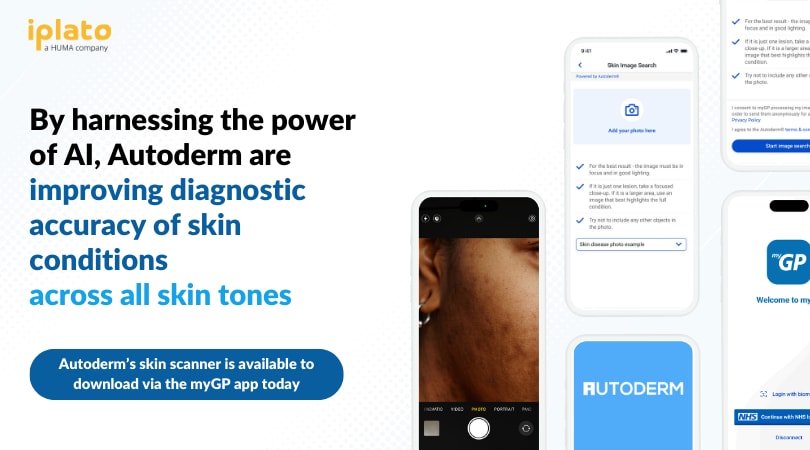
Autoderm and the myGP app, however, are changing the game! By harnessing the power of AI, Autoderm helps improve diagnostic accuracy of skin conditions across all skin tones. Their approach analyses a diverse search engine of skin images (2 million+), encompassing various ethnicities and skin tones. Their algorithm is constantly evolving and learning along with their growing bank of images. Irrespective of skin tone, myGP users can use the tech to get likely answers quickly, easily and choose how to act on the insight.


© 2026 iPLATO. All rights reserved
Practice Area
/
Making skin health accessible for all: unveiling the challenges in diagnosing skin conditions on darker skin
Expanding Choice. Simplifying Access. Improving Health.
December 7, 2020
The skin is the largest organ of the human body and acts as a protective barrier between the external environment and the inside of the body, shielding the internal organs against heat, light, injury and infection. Yet, the journey to diagnose skin conditions, especially on darker skin tones, can be challenging and not well mapped. In a recent study, physicians were presented with 364 images spanning 46 skin diseases and asked to submit up to four differential diagnoses. The physicians were four percentage points less accurate for the diagnosis of images of dark skin as compared to light skin.
Inherent biases deeply rooted in medical research, literature, and education have led to a healthcare landscape skewed towards lighter skin, often leaving behind those with darker complexions. Doctors diagnose around one-quarter of melanoma cases in Black people when cancer has already spread to nearby lymph nodes. However, amidst these challenges, there are technological advancements, such as AI, that are helping to rectify this imbalance. In May 2024, Autoderm conducted a total of 18,359 analyses through the myGP app and identified 79 cases of melanoma. This equates to about 2-3 melanoma diagnoses per day. Given that approximately 46 melanomas are diagnosed daily across the UK, the cases detected via the myGP app represent about 5% of the total daily melanoma diagnoses in the UK population.
We recognise the need for equitable healthcare solutions for all. Through our partnership with Autoderm, launched in 2023 after years of clinical and AI research, are proud to offer their next generation skin scanner to our community of 3 million users via the myGP app.
The bias in dermatology towards lighter skin tones is a well-documented issue. From medical textbooks to research studies, most visual references and diagnostic criteria are based on observations of mainly fair-skinned individuals.This bias perpetuates a cycle of misdiagnosis and inadequate treatment for patients with darker skin, which can lead to unnecessary distress and prolonged health issues such as increased itching, dryness, skin thickening and hyperpigmentation.
Autoderm and the myGP app, however, are changing the game! By harnessing the power of AI, Autoderm helps improve diagnostic accuracy of skin conditions across all skin tones. Their approach analyses a diverse search engine of skin images (2 million+), encompassing various ethnicities and skin tones. Their algorithm is constantly evolving and learning along with their growing bank of images. Irrespective of skin tone, myGP users can use the tech to get likely answers quickly, easily and choose how to act on the insight.
© 2026 iPLATO. All rights reserved
Expanding Choice. Simplifying Access. Improving Health.
December 7, 2020

Last month we (re)introduced to you, the myGP® engagement platform; an integrated approach to digital healthcare which empowers patients, transforms access, improves health outcomes and reduces costs.
Encouraged by the NHS this month, we are taking this one step further in our pursuit of promoting patient choice. We have been working tirelessly to ensure that we don’t just simplify communication and increase engagement for our primary care customers, but we also increase access and bring more choice to our patients.
As a next step in our evolving platform, we are introducing within our app the myGP marketplace – beginning its rollout on Monday, 07 December. We have partnered with a number of healthcare organisations across a range of sectors – from mental health to physiotherapy to wellness and nutrition – in order to offer our users simplified access to first-class healthcare services throughout the UK. Some of our partners, such as IESO and Echo are NHS funded. Others, such as My Online Therapy, VHPGO, Forth, GPDQ, Medbelle, and Ascenti are self-pay. Carefully selected to complement the NHS, they all meet our exacting partner criteria and share our ultimate goal of simplifying access to healthcare. You can learn more about how we work with our partners here.
Alongside the expansion of our patient offering, we now have made it easier than ever to access the care options available within our app. From today, patients will be able to remotely register for myGP, providing instant access to their medical records and electronic prescription ordering via NHS Login.
We anticipate that this will make the lives of our NHS partners simpler as well, as patients no longer need to call their practice to gain their NHS online credentials or be verified by the surgery to access their NHS prescriptions and medical records. Ultimately, this capability will allow practice managers and their administrative teams to focus on the patients who need them the most. And shouldn’t that be the ultimate goal?
We don’t need to remind anyone of how challenging 2020 has been. Our hope, indeed, our belief, is that the adoption of health tech innovations has, in the end, made 2020 a little bit easier for everyone. By bringing patients greater choice when it comes to their healthcare and making it easier for many of us to access those choices, we hope that we’ve contributed in some way to the positive impact of health tech this year, for everyone.
We will continue to work hard to increase access and choice for patients, while working with our clinical advisors to develop and improve our offering to our NHS partners.
Many thanks, and take care,
Tobias
© 2026 iPLATO. All rights reserved