
/
Making skin health accessible for all: unveiling the challenges in diagnosing skin conditions on darker skin
Celebrating 75 years of the NHS
July 13, 2023
The skin is the largest organ of the human body and acts as a protective barrier between the external environment and the inside of the body, shielding the internal organs against heat, light, injury and infection. Yet, the journey to diagnose skin conditions, especially on darker skin tones, can be challenging and not well mapped. In a recent study, physicians were presented with 364 images spanning 46 skin diseases and asked to submit up to four differential diagnoses. The physicians were four percentage points less accurate for the diagnosis of images of dark skin as compared to light skin.
Inherent biases deeply rooted in medical research, literature, and education have led to a healthcare landscape skewed towards lighter skin, often leaving behind those with darker complexions. Doctors diagnose around one-quarter of melanoma cases in Black people when cancer has already spread to nearby lymph nodes. However, amidst these challenges, there are technological advancements, such as AI, that are helping to rectify this imbalance. In May 2024, Autoderm conducted a total of 18,359 analyses through the myGP app and identified 79 cases of melanoma. This equates to about 2-3 melanoma diagnoses per day. Given that approximately 46 melanomas are diagnosed daily across the UK, the cases detected via the myGP app represent about 5% of the total daily melanoma diagnoses in the UK population.
We recognise the need for equitable healthcare solutions for all. Through our partnership with Autoderm, launched in 2023 after years of clinical and AI research, are proud to offer their next generation skin scanner to our community of 3 million users via the myGP app.
The bias in dermatology towards lighter skin tones is a well-documented issue. From medical textbooks to research studies, most visual references and diagnostic criteria are based on observations of mainly fair-skinned individuals.This bias perpetuates a cycle of misdiagnosis and inadequate treatment for patients with darker skin, which can lead to unnecessary distress and prolonged health issues such as increased itching, dryness, skin thickening and hyperpigmentation.
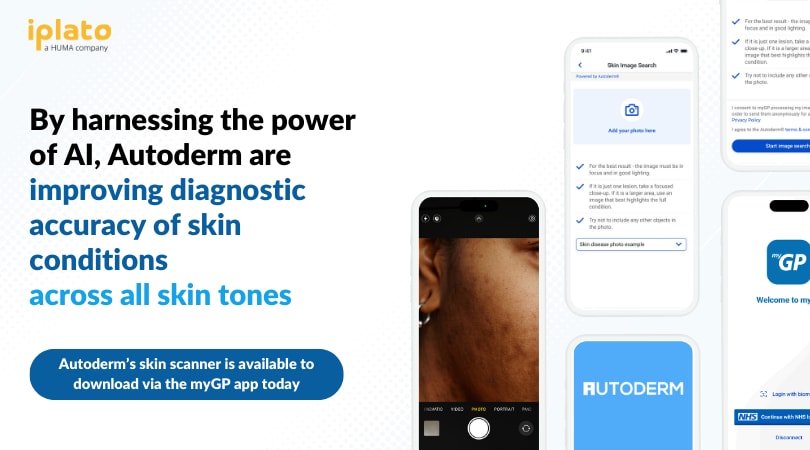
Autoderm and the myGP app, however, are changing the game! By harnessing the power of AI, Autoderm helps improve diagnostic accuracy of skin conditions across all skin tones. Their approach analyses a diverse search engine of skin images (2 million+), encompassing various ethnicities and skin tones. Their algorithm is constantly evolving and learning along with their growing bank of images. Irrespective of skin tone, myGP users can use the tech to get likely answers quickly, easily and choose how to act on the insight.


© 2026 iPLATO. All rights reserved
Practice Area
/
Making skin health accessible for all: unveiling the challenges in diagnosing skin conditions on darker skin
Celebrating 75 years of the NHS
July 13, 2023
The skin is the largest organ of the human body and acts as a protective barrier between the external environment and the inside of the body, shielding the internal organs against heat, light, injury and infection. Yet, the journey to diagnose skin conditions, especially on darker skin tones, can be challenging and not well mapped. In a recent study, physicians were presented with 364 images spanning 46 skin diseases and asked to submit up to four differential diagnoses. The physicians were four percentage points less accurate for the diagnosis of images of dark skin as compared to light skin.
Inherent biases deeply rooted in medical research, literature, and education have led to a healthcare landscape skewed towards lighter skin, often leaving behind those with darker complexions. Doctors diagnose around one-quarter of melanoma cases in Black people when cancer has already spread to nearby lymph nodes. However, amidst these challenges, there are technological advancements, such as AI, that are helping to rectify this imbalance. In May 2024, Autoderm conducted a total of 18,359 analyses through the myGP app and identified 79 cases of melanoma. This equates to about 2-3 melanoma diagnoses per day. Given that approximately 46 melanomas are diagnosed daily across the UK, the cases detected via the myGP app represent about 5% of the total daily melanoma diagnoses in the UK population.
We recognise the need for equitable healthcare solutions for all. Through our partnership with Autoderm, launched in 2023 after years of clinical and AI research, are proud to offer their next generation skin scanner to our community of 3 million users via the myGP app.
The bias in dermatology towards lighter skin tones is a well-documented issue. From medical textbooks to research studies, most visual references and diagnostic criteria are based on observations of mainly fair-skinned individuals.This bias perpetuates a cycle of misdiagnosis and inadequate treatment for patients with darker skin, which can lead to unnecessary distress and prolonged health issues such as increased itching, dryness, skin thickening and hyperpigmentation.
Autoderm and the myGP app, however, are changing the game! By harnessing the power of AI, Autoderm helps improve diagnostic accuracy of skin conditions across all skin tones. Their approach analyses a diverse search engine of skin images (2 million+), encompassing various ethnicities and skin tones. Their algorithm is constantly evolving and learning along with their growing bank of images. Irrespective of skin tone, myGP users can use the tech to get likely answers quickly, easily and choose how to act on the insight.
© 2026 iPLATO. All rights reserved
Celebrating 75 years of the NHS
July 13, 2023
For the 75th anniversary of the NHS, we sat down with iPLATO’s founder and CEO, Tobias Alpsten, to discuss his personal and professional experience with the NHS over the years.
What was the first interaction you had with the NHS?
The first, and perhaps one of the most memorable interactions with the NHS was the birth of my eldest child. Although we encountered complications along the way I am grateful to say this experience was a positive one and my family were supported and cared for to the highest standard, making this moment a joyous one. This personal tie to the NHS sparked a lifelong passion to make healthcare accessible for all through supporting the NHS.
What inspired you to found iPLATO?
In the early 2000s, technology was evolving quickly. I had set up a consultancy and application developer to help other companies harness the use of these technological advancements. Having had personal interest in healthcare and positive interactions with the NHS over the years, I identified healthcare being a key sector that could utilise technology to simplify access to healthcare, for all.
What are some key highlights along the way for you?
In 2005, we launched the first patient facing pilot of iPLATO Patient Care Messaging integrated with EMIS. A more modern version exists now, but it remains to be the foundation of our services.
Another key moment for me was the establishment of iPLATO’s Population Health Service which combined communication tools and behavioral insights to improve uptake of cancer screening services. It has been a privilege to watch this service grow and produce groundbreaking outcomes. For example, our role in increasing cervical cancer screening, in partnership with NHS England and North of England CSU. iPLATO’s ‘nudge’ to patients eligible for this service, increased screening by 6.3%, saving 706 lives.
Finally, becoming part of the Huma group in 2021 was pivotal for iPLATO. By combining expertise, iPLATO and Huma were able to create an ecosystem to enable proactive, predictive, and personalized care across primary and secondary care, all while supporting the NHS.
Do you have any hopes for the NHS in the next 75 years?
I have been grateful to have positive experiences with the NHS over the years, though I understand that unfortunately for some, this is not always the case. I hope the NHS will continue to grow and become more accessible for everyone, particularly those who tend to be less represented within the service. Our role as an innovation partner is to help the NHS predict and diagnose disease before symptoms occur and to support people though treatment and in managing their long term conditions. Ensuring digital adoption across primary and secondary care will result in better population health and a system that is more engaging and transforms healthy life expectancy for all.
© 2026 iPLATO. All rights reserved