

/
Making skin health accessible for all: unveiling the challenges in diagnosing skin conditions on darker skin
British public support vaccine passports to save their local venues
February 23, 2021
The skin is the largest organ of the human body and acts as a protective barrier between the external environment and the inside of the body, shielding the internal organs against heat, light, injury and infection. Yet, the journey to diagnose skin conditions, especially on darker skin tones, can be challenging and not well mapped. In a recent study, physicians were presented with 364 images spanning 46 skin diseases and asked to submit up to four differential diagnoses. The physicians were four percentage points less accurate for the diagnosis of images of dark skin as compared to light skin.
Inherent biases deeply rooted in medical research, literature, and education have led to a healthcare landscape skewed towards lighter skin, often leaving behind those with darker complexions. Doctors diagnose around one-quarter of melanoma cases in Black people when cancer has already spread to nearby lymph nodes. However, amidst these challenges, there are technological advancements, such as AI, that are helping to rectify this imbalance. In May 2024, Autoderm conducted a total of 18,359 analyses through the myGP app and identified 79 cases of melanoma. This equates to about 2-3 melanoma diagnoses per day. Given that approximately 46 melanomas are diagnosed daily across the UK, the cases detected via the myGP app represent about 5% of the total daily melanoma diagnoses in the UK population.
We recognise the need for equitable healthcare solutions for all. Through our partnership with Autoderm, launched in 2023 after years of clinical and AI research, are proud to offer their next generation skin scanner to our community of 3 million users via the myGP app.
The bias in dermatology towards lighter skin tones is a well-documented issue. From medical textbooks to research studies, most visual references and diagnostic criteria are based on observations of mainly fair-skinned individuals.This bias perpetuates a cycle of misdiagnosis and inadequate treatment for patients with darker skin, which can lead to unnecessary distress and prolonged health issues such as increased itching, dryness, skin thickening and hyperpigmentation.
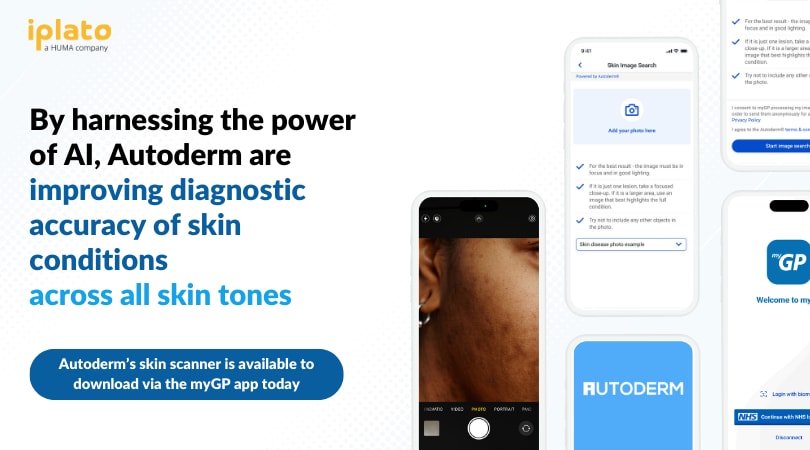
Autoderm and the myGP app, however, are changing the game! By harnessing the power of AI, Autoderm helps improve diagnostic accuracy of skin conditions across all skin tones. Their approach analyses a diverse search engine of skin images (2 million+), encompassing various ethnicities and skin tones. Their algorithm is constantly evolving and learning along with their growing bank of images. Irrespective of skin tone, myGP users can use the tech to get likely answers quickly, easily and choose how to act on the insight.


© 2026 iPLATO. All rights reserved
Practice Area
/
Making skin health accessible for all: unveiling the challenges in diagnosing skin conditions on darker skin
British public support vaccine passports to save their local venues
February 23, 2021
The skin is the largest organ of the human body and acts as a protective barrier between the external environment and the inside of the body, shielding the internal organs against heat, light, injury and infection. Yet, the journey to diagnose skin conditions, especially on darker skin tones, can be challenging and not well mapped. In a recent study, physicians were presented with 364 images spanning 46 skin diseases and asked to submit up to four differential diagnoses. The physicians were four percentage points less accurate for the diagnosis of images of dark skin as compared to light skin.
Inherent biases deeply rooted in medical research, literature, and education have led to a healthcare landscape skewed towards lighter skin, often leaving behind those with darker complexions. Doctors diagnose around one-quarter of melanoma cases in Black people when cancer has already spread to nearby lymph nodes. However, amidst these challenges, there are technological advancements, such as AI, that are helping to rectify this imbalance. In May 2024, Autoderm conducted a total of 18,359 analyses through the myGP app and identified 79 cases of melanoma. This equates to about 2-3 melanoma diagnoses per day. Given that approximately 46 melanomas are diagnosed daily across the UK, the cases detected via the myGP app represent about 5% of the total daily melanoma diagnoses in the UK population.
We recognise the need for equitable healthcare solutions for all. Through our partnership with Autoderm, launched in 2023 after years of clinical and AI research, are proud to offer their next generation skin scanner to our community of 3 million users via the myGP app.
The bias in dermatology towards lighter skin tones is a well-documented issue. From medical textbooks to research studies, most visual references and diagnostic criteria are based on observations of mainly fair-skinned individuals.This bias perpetuates a cycle of misdiagnosis and inadequate treatment for patients with darker skin, which can lead to unnecessary distress and prolonged health issues such as increased itching, dryness, skin thickening and hyperpigmentation.
Autoderm and the myGP app, however, are changing the game! By harnessing the power of AI, Autoderm helps improve diagnostic accuracy of skin conditions across all skin tones. Their approach analyses a diverse search engine of skin images (2 million+), encompassing various ethnicities and skin tones. Their algorithm is constantly evolving and learning along with their growing bank of images. Irrespective of skin tone, myGP users can use the tech to get likely answers quickly, easily and choose how to act on the insight.
© 2026 iPLATO. All rights reserved
British public support vaccine passports to save their local venues
February 23, 2021
- New research from myGP has indicated that 66% of residents in England would welcome temporary vaccine passports to allow local hard-hit venues and businesses to get up-and-running
- Of the 34% that said they disagreed, a third of them (32%) would change their mind if their favourite high-street venue was at risk of closure before social distancing measures could be removed
- 92% of public-facing businesses would consider inviting vaccinated customers back into their premises as a short-term, but urgent lifeline
New research has revealed that 66% of public in England would welcome vaccination passports if it meant keeping their local high-street in businessi. The statistics follow a U-turn in announcements from Government that suggest vaccine passports could now be required on the high-street, but it still leaves the future uncertain for tens of 1000s of businesses as the country moves forward into the ‘roadmap out of lockdown’.
31% of UK businesses who have paused trading or are temporarily closed have no or low confidence in surviving the next three months with 55% having less than 6 months’ cash reserves and as many as 10% of businesses currently not trading listing no cash reserves at all.ii
myGP – the UK’s largest independent healthcare management app – has been inundated with enquiries from business owners after announcing its intention to provide the people in England with a simple, clear means of communicating their verified vaccination status, via the myGP TICKet feature within their app. 92% of owners of independent public-facing businesses confirmed that they are considering inviting customers who can prove their vaccination status back as soon as possible at capacity events, in an attempt to avoid looming closures.iii
In the Prime Minister’s current plans – the earliest venues will be able to operate at capacity is the 21st June, which means many small independent music venues will be unable to open, until this date – due to their size and set-up.
Mark Davyd, CEO of Music Venue Trust commented “Grassroots music venues across the country have enjoyed huge support from artists and audiences during this crisis and it is incredibly encouraging to see broad public support of vaccine verification as we consider a number of options to revive live music. The situation remains dire right across the events and entertainment sector. Economically viable events can’t happen with social distancing, and vaccine verification is one of a number of tools which venues can use to get back to full capacity so we can reopen every venue safely”
The love for the local high-street and England’s independent venues was further confirmed with 32% of people who were initially against the temporary vaccine passports, stating they would change their mind if it meant saving their favourite local venue from closure.i
Hillary Cannon, Director of the myGP TICKet Innovation, comments on why vaccination verification technology really is key to the survival of small businesses in particular:
“We all know that lockdowns and social distancing has brought arts and events venues, restaurants, and the hospitality sector – all of our most beloved industry sectors – to their knees. We also know that there are still questions around the reliability of rapid (lateral flow) testing, and that PCR testing does not account for the incubation period of this virus. It’s clear that assured, GP-verified proof of vaccination is the only way to ensure that businesses can reopen safely and at capacity. And we now realise that the majority of the public supports the use of such technologies.”
The myGP TICKet will allow businesses whose viability depends upon operating at capacity – such as the retail, leisure, the arts and hospitality sectors – the ability to open either full or part-time to vaccinated individuals, without the need to observe strict social distancing rules. In addition, the technology will reduce the administrative burden on GPs, removing personal requests for verification of vaccination status as people begin to return to everyday life around the country.
Dr William Budd, research clinician and advisor to myGP comments: “It’s really encouraging to see this type of innovation, particularly given the positive comments relating to the Oxford vaccine in The?Lancet. Speeding up a return to normal with this technology and a vaccine that?looks to prevent transmission?is a brilliant combination.”
About the new vaccination status feature that will help to save UK venues
The new vaccination status feature will display, within the patient profile page of the myGP app, whether or not a patient is sufficiently protected from COVID-19; illustrated via a few personal details and a simple green tick, which will appear 12 days following the final vaccine dose, when a patient is considered protected from the virus. This ‘tick’ will act as a clinically assured means of proving one’s vaccination status, displayed in real-time, generated directly from a patient’s medical record. All data and access is controlled by the patient.
myGP – home to the myGP TICKet feature – is developed by Hammersmith-based iPLATO Healthcare. Currently available to patients at 97 percent of England’s GP practices, myGP has spent years working alongside the NHS to gain NHS accreditation. As a result, the app already enables over two million patients in England to view their medical records, request repeat prescriptions, request GP appointments, and access other complementary healthcare services. More than 200,000 patients in England have accessed their medical records via the app in just the last two months.
© 2026 iPLATO. All rights reserved